Skip to content

Renewable Energy on Farm: What Every Farmer Should Know Before Investing

farmerknowsnothing
farmerknowsnothing Admin

Stockperson

#1 ·

Solar, wind, hydro, biomass and batteries can reduce energy costs, create additional income and make a farm less exposed to volatile energy prices — but only when the system suits the farm, the grid connection works, planning is understood and the financial case survives realistic assumptions.

Renewable energy has become one of the biggest diversification opportunities available to farms.

A modern agricultural business may consume substantial amounts of electricity and heat through grain drying, milk cooling, ventilation, refrigeration, irrigation, workshops, lighting, pumps, poultry housing, livestock buildings and domestic accommodation.

That creates an obvious question:
Instead of buying all that energy, could the farm produce some of it itself?

For many farms, the answer is yes.

But renewable energy should not begin with choosing solar panels, a wind turbine or a battery.
It should begin with understanding when, where and how the farm uses energy.

A badly designed renewable project can tie up large amounts of capital while producing electricity when the farm does not need it. A well-designed system can reduce purchased electricity, protect the business against future price increases and, in some cases, create another income stream.

The most important principle is therefore simple:

Do not buy renewable technology first and work out how to use the energy afterwards. Measure the farm's energy demand first, then design the technology around it.

1. Start with your electricity bills, not a solar brochure

Before requesting quotations, collect at least 12 months of electricity and fuel information.

Ideally, examine several years.

Record:

- Annual electricity consumption.
- Monthly electricity consumption.
- Day and night usage.
- Half-hourly consumption where available.
- Maximum electrical demand.
- Electricity unit price.
- Standing charges.
- Heating oil, LPG, gas or biomass consumption.
- Diesel used for stationary processes.
- Major electrical equipment.
- Seasonal peaks.
- Planned expansion of the farm.

This matters because two farms using exactly 100,000 kWh per year may require completely different renewable systems.

A dairy farm may have relatively consistent daily electricity demand from milking, refrigeration and water heating.
A grain enterprise may use enormous amounts of energy during harvest and relatively little during the rest of the year.
A poultry farm may require continuous ventilation and heating.
A horticultural business may have substantial pumping, refrigeration or glasshouse demand.

Therefore, annual energy use alone is not enough.

The timing of consumption matters just as much as the total amount consumed.

2. Solar PV: Often the first renewable technology farmers consider

Solar photovoltaic panels convert daylight into electricity.

Agricultural buildings can offer excellent installation opportunities because barns, poultry sheds, stores, dairies and

workshops often have large roof areas.

Solar can potentially supply electricity for:

- Milk cooling.
- Refrigeration.
- Ventilation.
- Pumps.
- Workshops.
- Offices.
- Grain handling.
- Electric vehicle charging.
- Water heating through electrically powered systems.
- Battery charging.

The most valuable solar electricity is often the electricity you use yourself

Suppose the farm normally pays 25p per kWh for electricity.

If a solar array produces electricity that is immediately consumed on the farm, the business may avoid purchasing that unit at approximately the retail electricity price.

If the same electricity is exported, the farm may receive a different and potentially lower export payment depending on its tariff or agreement.

This means self-consumption can be extremely important to project economics.

A solar installer may proudly say:
“This system will generate 100,000 kWh per year.”

The better question is:

How much of those 100,000 kWh will my farm actually use when they are generated?
3. Roof-mounted solar or ground-mounted solar?

Roof-mounted solar
Agricultural buildings can make excellent locations because the panels use an existing structure rather than occupying additional land.

However, farmers should investigate the roof before installing anything.
Consider:

- Structural loading.
- Roof condition.
- Remaining roof life.
- Asbestos-containing materials.
- Orientation.
- Shading.
- Access for installation.
- Fire separation.
- Insurance requirements.
- Future building alterations.

Installing a solar array expected to operate for decades on a roof that will require replacement in five years could create unnecessary expense.

A structural assessment may therefore be one of the most valuable parts of the project.

Ground-mounted solar
Ground arrays can allow better orientation and easier maintenance.

However, they can affect agricultural land use and may face more complex planning considerations.

In England, government planning guidance places particular emphasis on considering agricultural land quality and protecting the best and most versatile agricultural land from significant inappropriate development. GOV.UK

The planning position depends on the location, scale and circumstances of the development, so the local planning authority should be consulted before committing to a project. GOV.UK specifically advises farmers to check whether permitted development rights apply and whether approval or full permission is required. GOV.UK

4. Do not assume planning permission is automatic

One of the biggest mistakes in farm renewable development is assuming:

“It is agricultural land, so I can build it.”

That is not necessarily correct.

Planning requirements can depend on:

- Technology.
- System size.
- Location.
- Building type.
- Listed-building status.
- Conservation areas.
- Landscape designation.
- Agricultural land classification.
- Height.
- Noise.
- Visual impact.
- Access.
- Ecological effects.

Some agricultural development can benefit from permitted development rights, but conditions and limitations apply. GOV.UK recommends checking with the relevant local planning authority before starting work. GOV.UK

Never place a large equipment order on the assumption that planning will be straightforward.

5. Grid connection: The part of the project many farmers discover too late

A renewable installation may produce electricity perfectly while still being unable to export everything it generates.

Why?

Because the local electricity network has limited capacity.

Before installing larger generation systems, farmers may need approval from the relevant Distribution Network Operator, commonly called the DNO.

Depending on the project, the network may require:

- Connection studies.
- Additional protection equipment.
- Export limitations.
- Network reinforcement.
- New transformers.
- Cable upgrades.
- Connection charges.

In some locations, export capacity can become the factor that determines whether a project is financially viable.

Example
Imagine a farm proposes a:
250 kW solar installation
but the network operator allows only:
100 kW maximum export.
That does not necessarily make the project impossible.

The farm might:

- Consume more electricity on site.
- Install export-limiting equipment.
- Add battery storage.
- Reduce system size.
- Change the project design.

But that should be known before substantial capital is committed.

Always investigate grid capacity early.

6. Solar does not mean electricity independence

Solar output varies throughout the day and year.

Generation is generally strongest around daylight hours and during sunnier months.

A farm requiring substantial electricity at 5am, 10pm or throughout winter cannot assume solar alone will cover those requirements.

This creates the fundamental renewable-energy problem:

Generation does not always happen when demand occurs.

That is where energy storage becomes important.

7. Farm battery storage

Battery systems store electricity for use later.

They can potentially store:
- Excess solar generation.
- Wind generation.
- Cheaper off-peak grid electricity.
and release it when electricity would otherwise be purchased at a higher price.

Government planning guidance recognises battery energy storage as an important part of integrating intermittent renewable generation and providing electricity-system flexibility. GOV.UK

Batteries can help farms:

- Increase solar self-consumption.
- Reduce peak electricity demand.
- Shift electricity use between tariff periods.
- Limit grid export.
- Provide some resilience where the installation is designed for backup operation.
- Participate in some energy-market services where commercially available.

But batteries require careful financial analysis.

8. Understand kW and kWh before buying a battery

These two numbers are frequently confused.

kW = power

This describes how quickly energy can be delivered.

kWh = energy capacity

This describes how much energy is stored.

Consider a:

100 kW / 200 kWh battery.

It could theoretically provide approximately:
- 100 kW for 2 hours,
- 50 kW for 4 hours,
subject to system limits, efficiency, state of charge and usable capacity.

A farm requiring 250 kW during a peak cannot assume that a 50 kW battery will remove that peak simply because the battery has a

large kWh capacity.

Both numbers matter.

9. Battery degradation is part of the cost
Batteries do not retain their original usable capacity forever.

Performance can decline with:

- Age.
- Number of cycles.
- Temperature.
- Depth of discharge.
- Operating conditions.

When comparing battery quotations, ask:

- What is the usable capacity?
- What is the warranted capacity after 10 years?
- How many cycles are covered?
- What operating conditions apply to the warranty?
- Is inverter replacement included?
- What happens if individual modules fail?
- Who monitors the battery?
- Who owns the software/data?
- Is remote access dependent on a subscription?

The cheapest battery quotation may not represent the lowest lifetime cost.
farmerknowsnothing
farmerknowsnothing Admin

Stockperson

#2 · · edited 3 weeks ago

10. Battery fire safety must be taken seriously

Lithium-ion battery systems require proper design, installation and emergency planning.

Government guidance notes that lithium-ion storage presents a small but material fire risk and that this risk needs to be managed appropriately. GOV.UK

For planning applications involving lithium-ion battery storage of 1 MWh or more in England, government guidance encourages applicants to engage with the relevant fire and rescue service before submitting the application. GOV.UK

Farmers should consider:

- Battery location.
- Fire separation.
- Emergency access.
- Manufacturer requirements.
- Ventilation.
- Flood risk.
- Impact protection.
- Fire detection.
- Isolation arrangements.
- Insurer requirements.

A battery should never simply be placed wherever there happens to be spare space.

11. Wind power: Excellent on the right site, disappointing on the wrong one

Wind turbines can provide substantial renewable generation where wind resources are suitable.

Unlike solar, wind can generate at night and during winter.

This can potentially complement solar generation extremely well.

However, wind energy is highly site-dependent.

A turbine installed in a poor wind location may never achieve the output assumed in the sales quotation.

Important factors include:

- Average wind speed.
- Turbulence.
- Turbine height.
- Nearby trees.
- Buildings.
- Hills.
- Terrain.
- Grid availability.
- Planning constraints.
- Maintenance access.

The correct approach is to obtain reliable wind-resource information rather than relying solely on an installer saying:
“It is always windy around here.”

Local observation is useful, but investment decisions need better evidence.

12. Why turbine height matters

Wind closer to the ground experiences greater interference from buildings, vegetation and terrain.

Higher turbines may access stronger and more consistent airflow.

This is why a small turbine placed immediately behind a large farm building can perform poorly even though the surrounding area appears windy.

The location of the turbine can be as important as the turbine itself.

13. Wind maintenance can be underestimated

Solar panels contain no rotating blades.

Wind turbines do.

That means farmers should consider:

- Gearboxes.
- Bearings.
- Blades.
- Generators.
- Braking systems.
- Tower inspection.
- Electrical equipment.
- Specialist maintenance.
- Crane access.

Before purchasing a turbine, establish:

Who will maintain this machine in 10 or 15 years?

Also establish how quickly parts can be obtained if the manufacturer or installer disappears.

14. Small-scale hydro: Potentially one of the most dependable renewable resources

Farms with suitable rivers, streams, weirs or watercourses may have hydroelectric potential.

Hydropower can be particularly attractive because, where water flow is reliable, it may produce electricity continuously.

Solar may generate primarily during daylight.

Wind may vary hour by hour.

A suitable hydro resource may operate day and night.

But the site requirements are demanding.

Two fundamental characteristics determine hydro potential:
Head
The vertical fall in the water.

Flow
The quantity of water passing through the system.

A site with high flow but almost no drop may have limited potential.

A steep drop with insufficient flow may also produce little energy.

Both must be assessed.

15. Hydro requires environmental investigation

Using a watercourse is not simply an engineering question.

Projects may require consideration of:

- Water abstraction.
- Impoundment.
- Fish passage.
- Ecology.
- Flood risk.
- River flows.
- Protected habitats.
- Land ownership.
- Planning.
- Environment regulator permissions.

Farmers should establish the regulatory position before commissioning major civil engineering work.
Civil works such as channels, pipes, weirs and turbine houses may represent a significant part of project cost.

16. Biomass: Renewable energy based around heat

Biomass systems generally produce heat by burning fuels such as:

- Wood chips.
- Wood pellets.
- Logs.
- Other suitable biomass fuels.

They can be useful for farms with substantial heating requirements.

Possible applications include:

- Poultry buildings.
- Pig units.
- Workshops.
- Farmhouses.
- Offices.
- Hot water.
- Certain drying processes.

A biomass installation should be designed around genuine heat demand rather than around the idea of owning a renewable boiler.

17. Biomass fuel quality matters enormously

Two loads of woodchip can behave very differently.

Important characteristics include:

- Moisture content.
- Chip size.
- Contamination.
- Energy content.
- Storage conditions.

Wet fuel contains energy that must first be used evaporating water.

Poorly prepared fuel may also cause:

- Blockages.
- Incomplete combustion.
- Additional ash.
- Increased maintenance.
- Boiler shutdowns.

If a farm intends to produce its own wood fuel, harvesting, seasoning, drying, storage and handling must all be included in the economic calculation.

18. Do not base a new biomass investment on obsolete subsidy assumptions
This is particularly important.

The UK Non-Domestic Renewable Heat Incentive supported technologies including biomass, but the scheme is closed to new applicants. Existing accredited installations may continue to have obligations and payments under their existing arrangements. GOV.UK

Therefore, a salesperson presenting an old RHI-based return-on-investment calculation for a new project should immediately raise questions.

The current investment needs to stand on current energy savings, available incentives and realistic operating costs.

19. Solar thermal and heat pumps should not be forgotten

Renewable farm energy discussions often focus entirely on electricity.

But farms can also have substantial heat demand.

Solar thermal systems heat water rather than generating electricity.

Heat pumps move heat rather than creating it directly through combustion and can potentially be suitable for some farm buildings and processes.

Whether they are economically appropriate depends on:

- Required flow temperature.
- Building insulation.
- Heat demand.
- Electricity price.
- Existing heating system.
- Available heat source.
- Capital cost.

They should be assessed alongside biomass rather than automatically excluded from the discussion.

20. Anaerobic digestion deserves its own category

Although your forum description mentions biomass rather than biogas specifically, anaerobic digestion is highly relevant to farm renewable energy.

An anaerobic digester uses biological processes to break down organic material without oxygen.

Potential feedstocks can include:

- Slurry.
- Manure.
- Crop residues.
- Purpose-grown crops where appropriate.
- Food or organic wastes subject to regulation.

The resulting biogas can potentially be used for:

- Heat.
- Electricity.
- Combined heat and power.
- Biomethane production.

Digestate remains after digestion and can have agricultural nutrient value.

However, AD plants are complex businesses rather than simple pieces of farm machinery.

Feedstock supply, planning, environmental permitting, digestate handling, gas equipment and long-term maintenance must all be considered.

21. Renewable energy should not compete unnecessarily with food production

There is an important land-use question surrounding renewable energy.

Should highly productive agricultural land be removed from food production when roofs, yards, lower-grade land or dual-use systems could be available?

The answer differs between farms.

Government planning policy in England specifically recognises the importance of protecting high-quality agricultural land when
development proposals are assessed. GOV.UK

Solar development can sometimes coexist with agricultural activity.

Sheep grazing between solar arrays is one example.

There is also growing interest in agrivoltaics, where agricultural activity and electricity generation intentionally share land.

The correct design depends on the farming activity, machinery access, panel configuration and commercial arrangement.

22. Buying the system versus leasing the land or roof
Farmers may encounter several commercial models.

Farmer-owned
The farm purchases the renewable system.

Advantages can include:
- Ownership of the asset.
- Full benefit from electricity savings.
- Greater operational control.

Disadvantages include:
- Capital requirement.
- Financing risk.
- Maintenance responsibility.

Developer-owned
A third party installs and owns the equipment.

The farmer may receive:

- Roof rent.
- Land rent.
- Discounted electricity.
- A combination of payments.

The financial risk may be lower, but contractual commitments may last for decades.

Power Purchase Agreement

A developer installs or finances equipment and sells electricity to the farm under an agreed contract.

This may reduce initial capital requirements but requires careful review of:

- Electricity pricing.
- Inflation adjustments.
- Contract length.
- Minimum purchases.
- Maintenance.
- Termination rights.
- Property sale.
- Roof repairs.

Long contracts deserve professional legal review.

23. Never sign a 20- or 30-year renewable lease without understanding the end of it

Long-term renewable agreements may affect:
- Future farm sales.
- Mortgages.
- Land value.
- Tenancies.
- Succession.
- Development opportunities.
- Access rights.

Questions worth asking include:
- Who owns the panels?
- Who owns the cables?
- Who owns the battery?
- Who removes everything at the end?
- Who pays for removal?
- What happens if the operator becomes insolvent?
- Can the agreement be transferred?
- What happens if the farmer sells the land?
- Who repairs roof damage?
- Who is responsible for insurance?

The annual rent may look attractive.

24. Measure payback properly

Suppose a solar installation costs:

£120,000

and generates annual savings and income of:

£18,000

A simple payback calculation would be:

£120,000 ÷ £18,000 = 6.7 years

That looks attractive.

But it is incomplete.

A proper financial model should also consider:

- Finance costs.
- Maintenance.
- Insurance.
- Inverter replacement.
- Panel degradation.
- Export price changes.
- Electricity price changes.
- Tax treatment.
- Downtime.
- Grid charges.
- Monitoring fees.
- Opportunity cost of capital.

For larger projects, farmers should consider measures such as:

- Net present value.
- Internal rate of return.
- Discounted payback.
- Sensitivity analysis.

The contractual obligations can be more important.

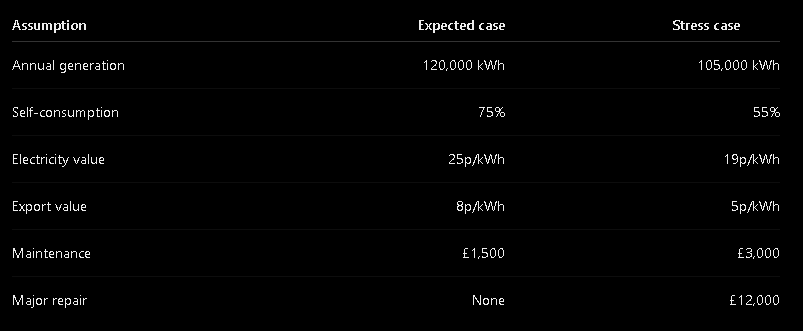
25. Always run a bad-case scenario

Sales projections usually show expected performance.

Farmers should also calculate what happens if conditions are worse.

For example:

Image

These figures are illustrative only.

If a project remains financially acceptable under conservative assumptions, the investment case is considerably stronger.

26. Generation guarantees need careful reading

A quotation may include a prediction such as:

“Expected annual generation: 150,000 kWh.”

That does not necessarily mean the installer guarantees 150,000 kWh.

Read the contract carefully.

Ask whether the figure is:

- A modelled estimate.
- A performance warranty.
- An equipment warranty.
- An insured guarantee.

These are very different things.

27. Renewable equipment must be insured correctly

Do not assume farm insurance automatically covers a major renewable installation.

Tell the insurer before installation.

Important issues can include:

- Fire.
- Lightning.
- Storm damage.
- Theft.
- Business interruption.
- Machinery breakdown.
- Public liability.
- Battery systems.
- Roof loading.
- Loss of renewable income.

Insurers may have specific requirements regarding equipment location and installation standards.

28. Cybersecurity is becoming part of farm energy security

Modern renewable installations are increasingly connected to the internet.

Solar inverters, batteries, energy management systems and smart meters may all have remote-access capability.

That brings convenience, but also creates cybersecurity issues.

Farmers should ask:

- Who has remote access?
- Is two-factor authentication available?
- Are default passwords changed?
- Who supplies software updates?
- Where is the operational data stored?
- What happens if the cloud service closes?
- Can the system operate without internet access?

Farm cybersecurity is becoming increasingly important as more machinery and infrastructure become connected.

29. Combining solar, wind and batteries can be more powerful than using one technology alone

A farm may discover that no single renewable source perfectly matches its demand.

Solar can perform strongly during summer days.

Wind may produce more during different weather and seasonal conditions.

Hydro may provide relatively continuous generation where the resource exists.

A battery can move some of that energy from one time period to another.

The farm can therefore be designed as an energy system rather than as a collection of unrelated machines.

Example

Solar → Battery → Dairy parlour → Milk cooling

During the day solar charges the battery.

During an evening milking, stored electricity helps supply the parlour and refrigeration load.

The actual economic benefit depends on generation, demand patterns, tariffs and system losses, but matching technologies can substantially improve utilisation.

30. Sometimes energy efficiency beats renewable generation
Before spending £100,000 generating additional electricity, ask whether £20,000 could reduce consumption permanently.

Possible improvements include:

- LED lighting.
- Variable-speed drives.
- Better insulation.
- Efficient refrigeration.
- Heat recovery.
- High-efficiency motors.
- Better ventilation controls.
- Improved grain-drying management.
- Fixing compressed-air leaks.
- Smart controls.

The cheapest unit of energy is often the one the farm no longer needs to buy.
Energy efficiency can also allow the renewable installation to be smaller and cheaper.

31. The farm should have an energy hierarchy

A sensible order is:

1. Measure consumption
↓
2. Eliminate unnecessary energy use
↓
3. Improve efficiency
↓
4. Generate renewable energy
↓
5. Increase self-consumption
↓
6. Store surplus where financially sensible
↓

7. Export remaining electricity
That approach prevents expensive generation equipment from compensating for avoidable waste.

32. Farming electricity demand may rise considerably
Renewable investment should consider what the farm may look like in 10 or 20 years.

Future electricity demand could increase through:

- Electric tractors.
- Electric loaders.
- Electric vans.
- Heat pumps.
- Robotic milking.
- Automated feeding.
- Grain drying.
- Irrigation.
- Refrigeration.
- Farm diversification.
- Workshops.
- EV charging.

Government energy policy anticipates significant long-term growth in electricity demand as more sectors electrify. GOV.UK

A system designed solely around today's electricity bill may therefore underestimate future opportunities.

33. But do not wildly oversize a system because “electricity will probably be needed”

Future demand should be based on a real business plan.

If the farm might purchase electric machinery in eight years, that does not automatically justify buying a huge solar array today.

Technology prices, tariffs and equipment may change.

A modular system that can be expanded could sometimes be more sensible.

34. Renewable energy grants can change — never assume an old scheme still exists

Agricultural renewable-energy support has changed repeatedly.

A grant advertised several years ago may no longer exist.

Eligibility can also depend on:

- Country within the UK.
- Farm type.
- Business structure.
- Technology.
- Installation date.
- Project size.

Always verify current funding conditions directly with the relevant government body before using a grant in the project's financial case.

The same applies to subsidy schemes.

For example, both the domestic and non-domestic Renewable Heat Incentive schemes are closed to new applicants.

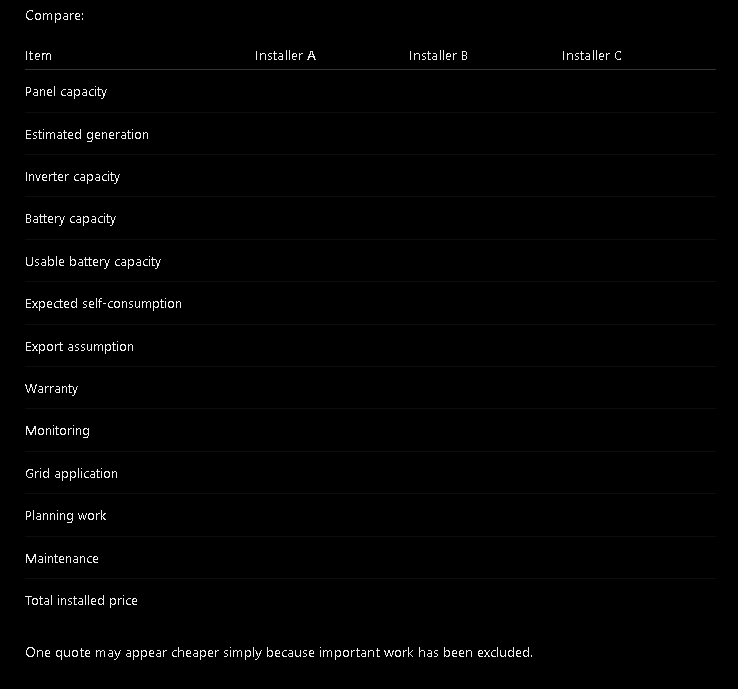
Image

36. Ask installers who actually carries the risk

Before choosing a contractor, establish:

- How long has the company traded?
- Who provides the equipment warranty?
- Who provides the workmanship warranty?
- What happens if the installer disappears?
- Who handles grid applications?
- Who handles planning?
- Who monitors performance?
- Who responds to faults?
- Where are replacement parts sourced?
- Is there a service agreement?

A 25-year panel warranty is not particularly useful if nobody is available to deal with a failure.

37. Keep renewable performance records

Once installed, monitor the system.

Record:

- Daily generation.
- Monthly generation.
- Imported electricity.
- Exported electricity.
- Self-consumed electricity.
- Battery charge/discharge.
- Faults.
- Maintenance.
- Downtime.
- Income.
- Savings.

A 200 kW system that quietly loses 15% of output through a fault could cost the farm substantial money before anyone notices.

Monitoring should therefore be considered part of maintenance.

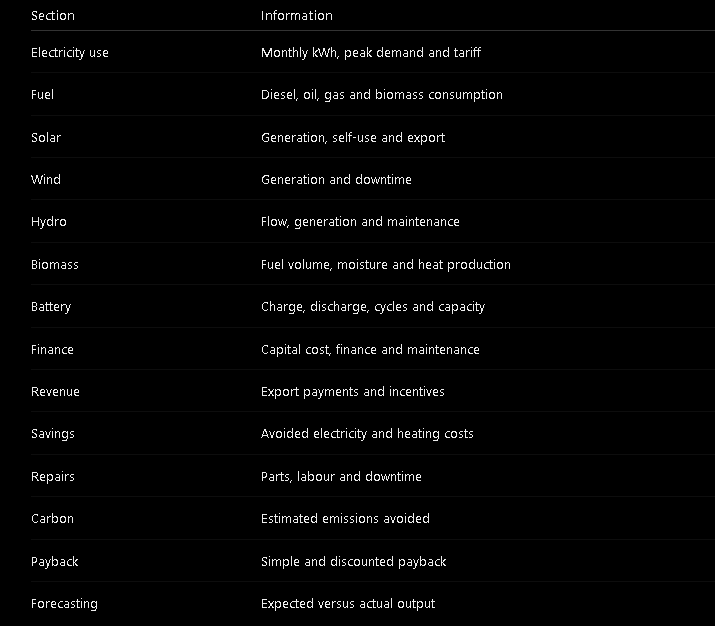
Image

The most powerful part is the expected versus actual column.

That quickly shows whether the project is performing as promised.

39. Questions to answer before spending £1

Before signing anything, answer these:

1. How much electricity and heat does the farm currently use?
2. At what time of day is it used?
3. How much could be eliminated through efficiency improvements?
4. Which renewable resource is strongest on this farm?
5. How much generation can realistically be consumed on site?
6. What export capacity is available?
7. Does planning permission apply?
8. What is the system's complete installed cost?
9. What maintenance is required?
10. What is the equipment lifespan?
11. What major component replacements are likely?
12. What happens when warranties expire?
13. What happens if electricity prices fall?
14. What happens if generation is lower than forecast?
15. What happens when the farm changes hands?
16. Who removes the equipment at the end of its life?

If these questions cannot be answered, the project is not ready.

farmerknowsnothing
farmerknowsnothing Admin

Stockperson

#3 ·

40. The most important renewable-energy calculation: Self-consumption

Imagine a farm solar array produces:

100,000 kWh per year.

Farm A

Uses 80,000 kWh directly.

Exports 20,000 kWh.

Farm B

Uses only 30,000 kWh directly.

Exports 70,000 kWh.

Both farms have exactly the same solar panels.

Yet their financial returns could be considerably different because Farm A avoids purchasing far more electricity.

That demonstrates why the farm's demand profile can be more important than simply installing the largest possible array.

41. Energy independence does not necessarily mean disconnecting from the grid

Some farmers use the phrase “energy independent” to mean producing as much energy annually as the farm consumes.

That is different from physically operating without a grid connection.

A farm might generate:

150,000 kWh annually

while consuming:

120,000 kWh annually

and still require grid electricity because generation and consumption happen at different times.

True off-grid operation requires sufficient generation, storage, backup capacity and system resilience to meet demand during prolonged low-generation periods.

For most existing grid-connected farms, reducing grid dependence may be more economically sensible than eliminating the connection entirely.

42. Emergency backup needs special design

A common misunderstanding is that:

“If I have solar panels and a battery, the farm will keep running during a power cut.”

Not necessarily.

Many standard grid-connected systems automatically disconnect during a network outage for safety reasons.

Backup capability requires equipment specifically designed to isolate safely from the grid and supply selected loads.

Critical farm loads should be identified.

These might include:

- Milking equipment.
- Milk refrigeration.
- Poultry ventilation.
- Water pumps.
- Feeding systems.
- Heating.
- Communications.
- Security.

Emergency power requirements should be designed separately from normal energy-saving calculations.

43. Renewable energy can become an entirely separate farm enterprise

At larger scale, energy production may no longer simply reduce the farm electricity bill.

It can become a diversification enterprise in its own right.

This may involve:

- Leasing land to developers.
- Grid-scale battery storage.
- Large solar installations.
- Wind development.
- Anaerobic digestion.
- EV charging.
- Commercial power sales.

At that stage farmers need more than an equipment installer.

Professional advice may include:

- Solicitor.
- Accountant.
- Tax adviser.
- Planning consultant.
- Grid consultant.
- Energy consultant.
- Land agent.
- Insurance adviser.

Large renewable projects can create substantial long-term value, but they can also affect land for decades.

44. Decommissioning should be planned on day one

Every renewable asset eventually reaches the end of its useful life.

Ask:

- Who removes the panels?
- Who removes foundations?
- Who removes underground cables?
- Who removes the battery?
- Who disposes of equipment?
- Can panels and batteries be recycled?
- Who pays?
- Must the land be restored?
- Is money reserved for decommissioning?

For leased land, these responsibilities should be clearly documented.

Do not leave the next generation of farmers with an expensive removal problem.

45. The bigger discussion: Should farms become energy producers as well as food producers?
This may become one of the most important agricultural debates of the coming decades.

Farmers already manage:

- Land.
- Water.
- Crops.
- Livestock.
- Buildings.
- Machinery.

Increasingly, they may also manage:

- Electricity generation.
- Battery storage.
- EV charging.
- Heat production.
- Grid services.

Renewable energy could give farms another source of income while making agricultural businesses less vulnerable to energy-price volatility.

But there is also a legitimate question about land use.

If good agricultural land can earn considerably more money producing electricity than producing food, what happens to farming?

There is no single answer.

Some renewable development competes directly with agricultural production.
Some uses farm roofs that would otherwise produce nothing.
Some allows continued grazing.
Some turns lower-quality land into an additional revenue source.
Some renewable systems primarily exist to supply the farming business itself.

The distinction matters.

A question for the farming community

For farmers who have already installed solar, wind, hydro, biomass or battery storage:

Did the installation actually achieve the savings promised when you bought it?

hich part surprised you most?

Was it:

- Grid connection?
- Planning?
- Maintenance?
- Battery performance?
- Export payments?
- Insurance?
- Finance?
- Actual generation?
- Installer support?

And perhaps most importantly:

If you were starting again tomorrow, would you install the same system, install something different, or invest in energy efficiency first?

Real farm figures are especially useful here.

A system producing impressive numbers on a sales brochure is one thing.

A system that has been operating through five British winters, machinery breakdowns, falling tariffs and real farm workloads is something entirely different.

Renewable energy should not be judged by the number of panels, turbine size or battery capacity installed. It should be judged by whether it makes the farming business more resilient, productive and financially sustainable.

Important
A disclaimer can help explain the intended use and limitations of your spreadsheet, but it cannot guarantee protection against legal claims or exclude liabilities that cannot lawfully be excluded. If you intend to distribute or sell the workbook, have a qualified solicitor review your disclaimer and any accompanying terms of use.

Sign in or create an account to reply.