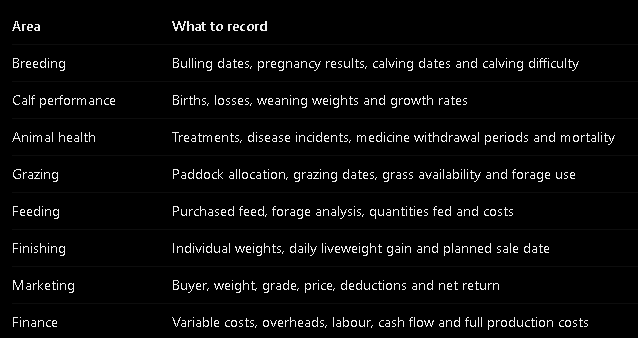
Suckler herds, finishing, grazing systems and getting a fair price — what every beef farmer should understand before the next breeding season, winter housing period or cattle sale.
Beef farming is often judged by the cattle standing in the field. A strong bull, healthy calves and well-finished animals are visible signs of good stockmanship. But the real performance of a beef enterprise is found in the less obvious details: the number of calves weaned per cow exposed to the bull, the cost of keeping that cow for a year, the quality of the grass she eats, the feed required to finish her offspring and the money left after every bill has been paid.
A farm can produce excellent cattle and still struggle financially. Equally, a smaller herd with good fertility, productive grassland, controlled costs and a reliable market can achieve a better financial result than a much larger operation.
The important question is not simply how much your cattle are worth when you sell them. It is how much it cost you to produce each kilogram of beef and whether the selling price rewards that investment.
This discussion focuses primarily on UK beef farming, although many of the principles apply to cattle producers elsewhere.
1. The first rule of beef farming: Know what one calf actually costs you
One of the most important figures in a suckler enterprise is the cost of producing a weaned calf.
Many farmers can tell you what their cattle made at market, but fewer can immediately tell you the complete cost of getting those animals there.
Consider everything involved in keeping a breeding cow:
- Winter forage, concentrates, minerals and bedding.
- Grazing, fertiliser, reseeding and grassland maintenance.
- Veterinary treatment, vaccinations and breeding costs.
- Bull purchase, upkeep and eventual replacement.
- Machinery, diesel, electricity, buildings and repairs.
- Land rent, finance, insurance and administration.
- Replacement heifers and the cost of maintaining unproductive animals.
- The farmer's own labour and the economic cost of using owned land.
The final two are particularly important. A business can appear profitable on paper while relying on the farmer working without a proper wage.
AHDB's 2024/25 suckler herd benchmarking illustrates just how dramatically production costs can differ between farms.
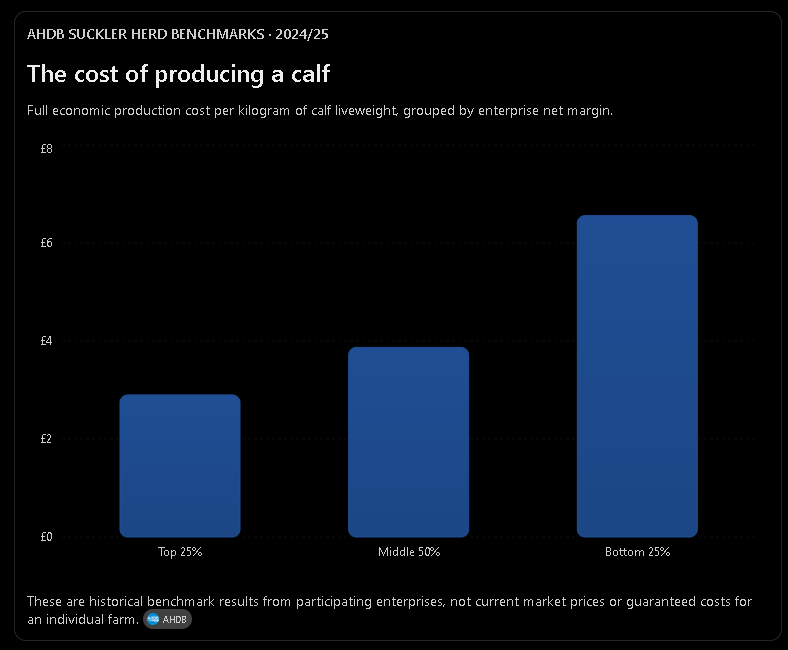
The lesson is that controlling costs can be just as important as achieving a higher selling price.
A farmer who increases the value of each calf by £100 but spends an additional £150 producing it has not improved the business.
A profitable animal is not necessarily the heaviest animal. It is an animal that produces a worthwhile margin after its entire cost of production has been accounted for.
2. Suckler herds: Fertility is the foundation of the business
A suckler cow has one primary productive responsibility: rear a healthy calf.
A cow that fails to conceive still consumes forage, occupies land, requires veterinary care and contributes to the farm's overheads.
This is why reproductive performance deserves the same attention as the market price of finished cattle.
What should a suckler farmer measure?
AHDB identifies several key performance indicators for breeding herds. Its published benchmarks include the following ranges for well-performing enterprises.
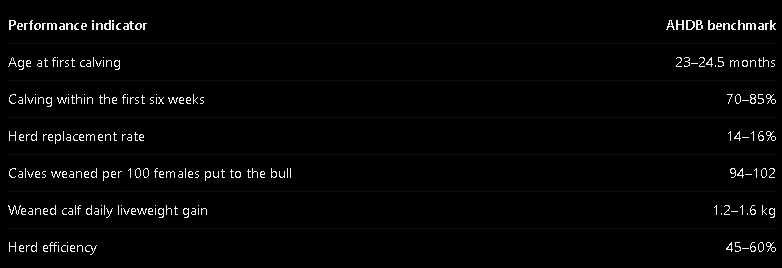
The benchmark ranges are reference points, not targets that should be pursued regardless of animal welfare, breed, land quality or the economics of an individual enterprise.
The calf-weaning figure can exceed 100 because of twins.
Why a compact calving season matters
A compact calving period allows farmers to manage cows with similar nutritional requirements, simplify veterinary work and produce more uniform groups of calves.
For spring-calving systems, it can also help align peak feed demand with spring grass growth.
A spread-out calving season may result in calves of significantly different ages and weights being sold together. That can complicate marketing and finishing decisions.
However, tightening a calving period must be planned carefully. Reducing bulling duration too abruptly without investigating underlying fertility problems could increase the number of empty cows.
Pregnancy diagnosis, bull fertility examinations, body-condition scoring and veterinary advice can help identify problems before the next breeding season.
Choosing the right breeding cow
The largest cow is not automatically the most productive cow.
A larger animal often needs more feed for maintenance. Whether she earns that additional feed depends on fertility, calf growth, longevity and the value of her offspring.
A practical breeding policy should consider maternal ability, temperament, calving ease, fertility, sound feet, suitability for local grazing and the market required for the calves.
Terminal traits matter when producing calves for beef, but they should not automatically take priority over maternal traits in a herd that retains its own replacement heifers.
A breeding cow should be judged on what she produces over her lifetime relative to what she costs to maintain.
3. Calving and calf survival: Protect the investment already made
By the time a cow calves, the business has already invested months of feed, land, labour and veterinary care.
Losing a calf at birth is therefore not simply the loss of an animal. It also reduces the economic return from the cow's entire breeding year.
Calving management should begin well before the expected due date.
Cows and heifers need appropriate body condition, balanced nutrition and suitable calving facilities. Excessive condition can contribute to difficulties, while inadequate nutrition can compromise cow and calf health.
During calving, farmers need to recognise normal progress, identify abnormal presentations and know when veterinary assistance is required.
After birth, the calf should be assessed promptly for breathing, vigour and its ability to stand and suckle. Early, adequate colostrum intake is essential because calves depend on it for important immune protection.
An agreed calf-health protocol with the farm vet should cover weak calves, difficult births, poor maternal behaviour, inadequate colostrum intake and signs of disease.
The English cattle welfare code also emphasises appropriate supervision of calving and competence in recognising when intervention is necessary. (GOV.UK)
4. Grass is a crop — and should be managed like one
Grassland is sometimes treated as land on which cattle happen to graze.
In a forage-based beef enterprise, it is the main feed-producing asset.
Every grazing decision affects both animal performance and the future productivity of the field.
Understanding grazing systems
Rotational grazing
Animals move through paddocks according to grass availability and recovery. This can improve control over grass utilisation, but requires planning, fencing, water access and regular monitoring.
Continuous grazing
Animals remain in a grazing area for an extended period. It may require less daily movement and infrastructure, but grass availability and selective grazing still need monitoring.
Strip grazing
Cattle are allocated a controlled area of forage at a time. It can help manage utilisation and allocation, particularly with forage crops, although wet conditions require careful soil and welfare management.
There is no single grazing system suitable for every farm.
A productive, free-draining lowland farm may be able to operate a very different system from an upland suckler enterprise with exposed grazing and a short growing season.
The correct stocking rate must reflect the land's actual ability to produce feed, particularly during periods of slow grass growth.
What happens when cattle damage wet ground?
Allowing cattle to remain on saturated ground can result in poaching, compaction and damage to the grass sward.
AHDB explains that this damage can reduce grass growth and create opportunities for weeds. Its recommended preventative measures include moving cattle off wet fields, adjusting stocking pressure, protecting gateways and changing the position of feeders and troughs. (AHDB)
The immediate temptation may be to keep grazing for a few extra days to avoid feeding stored forage.
But the real cost could be a damaged field that produces less grass for the remainder of the season.
Five things worth checking in every grazing rotation
1. Is sufficient grass available to meet the animals' nutritional needs?
2. Is the grass at the right stage of growth for the cattle being grazed?
3. Are the fields recovering adequately before the next grazing?
4. Is stocking pressure damaging the soil or leaving excessive waste?
5. Are all animals able to access adequate clean water and suitable shelter?
Regular grass measurement, soil testing and forage planning can turn grazing decisions from guesswork into a more measurable system.
5. Winter housing: The most expensive grass may be the grass you did not grow
Winter is often where a beef business faces its greatest financial pressure.
Housing can bring costs for silage, concentrates, bedding, machinery, labour, building maintenance and slurry handling.
Poor-quality forage can increase purchased-feed requirements. Inadequate ventilation and hygiene can also create animal-health problems.
Test forage before designing the ration
Two silage clamps may look similar while providing substantially different nutritional value.
Forage analysis helps establish dry matter, energy, protein and other characteristics needed to formulate a suitable ration.
AHDB's nutritional guidance demonstrates how forage quality can influence concentrate requirements and the cost of liveweight gain in dairy-beef finishing systems. (AHDB)
That principle also matters to suckler farmers.
Feeding high-quality silage to animals with relatively low nutritional requirements may waste valuable feed, while feeding poor forage to rapidly growing cattle without appropriate supplementation can restrict performance.
A forage budget should therefore match the available feed to the animals that need it.
Winter housing is also a welfare issue
Cattle require appropriate space, comfortable lying areas, clean water and sufficient ventilation.
Housing must also allow safe inspection, handling and isolation of sick animals.
Poor ventilation should not be confused with keeping cattle warm. A building that traps moisture and contaminated air can create serious health problems.
The English welfare code specifically addresses bedding, feeding and watering facilities, housing space, ventilation and the provision of suitable care for sick or injured cattle. (GOV.UK)
6. Finishing cattle: Know when extra weight stops paying
Finishing is where relatively small mistakes in feed cost, growth rate or sale timing can have a substantial effect on the final margin.
The objective is not simply to keep cattle until they reach the greatest possible weight.
It is to produce an animal that meets the intended buyer's specification at an economically sensible cost.
Understand daily liveweight gain
Daily liveweight gain measures the increase in an animal's weight over a given period.
For example, a steer gaining 90 kg over 75 days has achieved an average gain of 1.2 kg per day.
AHDB's beef-sector KPIs identify 1.5–1.7 kg per day as a benchmark range for well-performing beef finishing, although actual performance depends on animal type, production system and diet. (AHDB)
Growth rate is important because an animal that spends longer on the farm continues to consume feed and occupy housing or grazing.
However, rapid growth is not automatically profitable if it requires disproportionately expensive feed.
The finishing calculation farmers should make
Before retaining cattle for another month, compare the expected additional sale value with the costs of keeping them for that month.
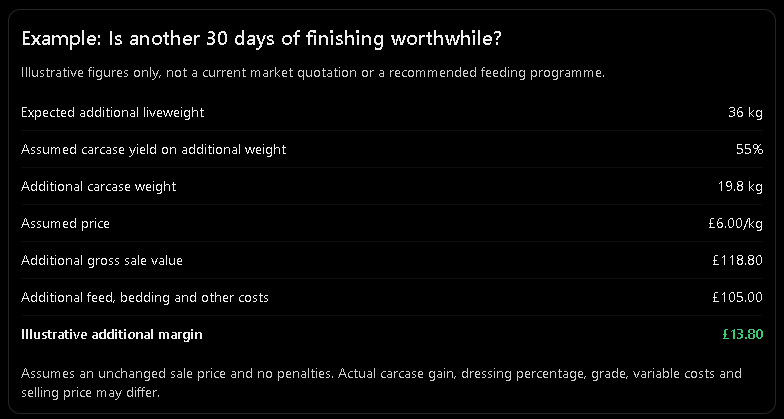
In this example, the extra month produces only a relatively small additional margin before any extra risk or capital costs.
If the animal becomes overfat, falls outside the weight specification or requires unexpected treatment, that margin could disappear.
This is why regular weighing and understanding the buyer's requirements are essential.
7. Getting a fair price: Understand what you are actually selling
A fair cattle price is about more than the headline pence-per-kilogram figure.
Two cattle buyers may offer different prices because they are purchasing for different markets, using different specifications or applying different deductions.
A farmer should understand the basis of the offer before comparing it with another.
Liveweight versus deadweight
Liveweight selling means the price is based on the animal's live weight, subject to the relevant sale arrangements.
Deadweight selling normally uses the weight of the dressed carcase and a pricing schedule that can take account of classification, weight and other contractual requirements.
The dressed carcase weighs less than the live animal. Dressing percentage varies with cattle type, condition, gut fill and dressing practice.
A deadweight quotation should therefore never be compared directly with a liveweight quotation without allowing for the difference in weight basis.