Skip to content

Posts by farmerknowsnothing

Arable Farming: The Decisions That Determine Yield, Soil Health and Whether the Crop Actually Makes Money

Arable · 2 weeks ago

7. Drilling date changes almost everything

Drilling is not simply about getting seed into the ground.

Timing can influence:

- Establishment.
- Weed competition.
- Disease.
- Pest risk.
- Crop development.
- Soil damage.
- Harvest timing.

The temptation during a difficult autumn is often:

“Just get it drilled.”

Sometimes that works.
Sometimes it creates an expensive crop planted into soil that was not ready.
Wet cultivation can smear soil.
Heavy machinery can compact it.
Seedbeds can become poor.
The crop may then struggle for the rest of the season.

A late crop planted well may sometimes outperform an early crop established badly.

Arable Farming: The Decisions That Determine Yield, Soil Health and Whether the Crop Actually Makes Money

Arable · 2 weeks ago

6. Variety selection is a business decision

A variety should not be chosen simply because it has the highest headline yield.

Farmers should consider:

- Disease resistance.
- Standing ability.
- Maturity.
- Soil suitability.
- Drilling date.
- Market acceptance.
- Grain quality.
- Regional performance.
- Lodging risk.
- Input requirements.

AHDB's Recommended Lists programme has historically assessed cereal and oilseed varieties for characteristics including yield, quality, disease resistance and agronomic
performance. AHDB

The important lesson is that yield potential is only one characteristic.

A slightly lower-yielding variety with better disease resistance may sometimes produce a better margin because it carries less risk or requires fewer inputs.

Arable Farming: The Decisions That Determine Yield, Soil Health and Whether the Crop Actually Makes Money

Arable · 2 weeks ago

5. Cereals: Wheat, barley and oats are not interchangeable

Cereals form the backbone of many UK arable rotations.

But each crop has different markets and agronomic requirements.

Wheat

Potential markets include:

- Milling.
- Feed.
- Distilling.
- Export.

A milling wheat contract may offer a premium.

But that premium usually depends on achieving specifications such as:

- Protein.
- Hagberg Falling Number.
- Specific weight.
- Moisture.
- Other contractual quality requirements.

Growing milling wheat without a realistic chance of achieving milling quality can mean paying for additional inputs and receiving feed-wheat value anyway.

Barley

Barley may be grown for:

- Feed.
- Malting.
- Brewing.
- Distilling.

Again, premium markets normally require specifications.

A malting contract can be attractive, but the crop has to meet the buyer's requirements.

Oats

Oats may offer a useful rotational alternative but marketing needs to be understood before drilling.

Food-grade and milling markets can have specific quality expectations.

Never assume that simply growing the crop means the premium market will accept it.

Arable Farming: The Decisions That Determine Yield, Soil Health and Whether the Crop Actually Makes Money

Arable · 2 weeks ago

4. A rotation should make agronomic and financial sense

A simple rotation might include:

Winter wheat → oilseed rape → winter wheat → beans

Another farm might use:

Winter wheat → spring barley → beans → winter wheat

Another could include:

- Oats.
- Linseed.
- Peas.
- Temporary grass.
- Cover crops.

There is no universally correct rotation.

The right choice depends on:

- Soil.
- Rainfall.
- Local markets.
- Storage.
- Machinery.
- Weed burden.
- Disease history.
- Labour.
- Contract availability.
- Environmental agreements.
- Gross margins.

The important question is not simply:

“Which crop pays the most this year?”

It is:

“What does this crop contribute to the profitability and resilience of the whole rotation?”

Arable Farming: The Decisions That Determine Yield, Soil Health and Whether the Crop Actually Makes Money

Arable · 2 weeks ago

3. Rotation may be the most important decision made before drilling

A crop should rarely be viewed in isolation.

Its real value includes what happens before and after it.

A good rotation can help:

- Break pest cycles.
- Reduce disease pressure.
- Diversify weed-control options.
- Improve soil structure.
- Introduce nitrogen-fixing crops.
- Spread drilling and harvesting workload.
- Reduce machinery pressure.
- Improve following-crop performance.

A poor rotation may do the opposite.

Continuous production of the same or similar crops can increase the selection pressure for certain weeds, pests and diseases.

That can make crop protection more difficult and expensive.

Arable Farming: The Decisions That Determine Yield, Soil Health and Whether the Crop Actually Makes Money

Arable · 2 weeks ago

2. Gross margin is useful — but do not stop there

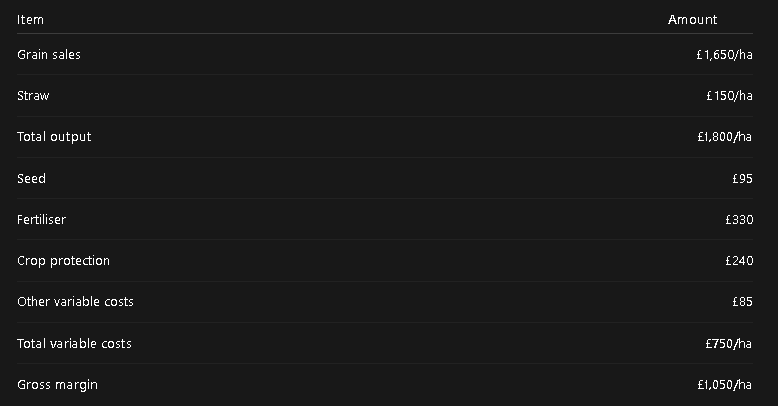
Gross margin normally compares crop output with variable costs.

For example:

Illustrative wheat crop

Image

These figures are illustrative only.

That £1,050 is not £1,050 profit.

The farm still has to pay for machinery, labour, rent, buildings, finance, administration and overheads.

This is why farmers should ideally understand three different figures:

1. Gross margin per hectare
2. Net margin per hectare
3. Cost per tonne produced

Together they provide a much better picture than yield alone.

Arable Farming: The Decisions That Determine Yield, Soil Health and Whether the Crop Actually Makes Money

Arable · 2 weeks ago

1. The first number every arable farmer should know: Cost per tonne

Farmers often talk about yield first.

“The wheat did 9 tonnes.”

That is useful information.

It is not enough.

Suppose two farms both harvest 9 tonnes per hectare.

Farm A

Production cost: £1,350/ha
Yield: 9 t/ha

Cost of production:
£150/t
Farm B

Production cost: £1,800/ha
Yield: 9 t/ha

Cost of production:
£200/t

Same crop.

Same yield.

Completely different business result.

A proper cost calculation should include:

- Seed.
- Fertiliser.
- Lime.
- Herbicides.
- Fungicides.
- Insecticides where legally and agronomically justified.
- Plant growth regulators where used.
- Machinery.
- Fuel.
- Repairs.
- Labour.
- Drying.
- Storage.
- Haulage.
- Rent.
- Finance.
- Contractor charges.
- Depreciation.
- Insurance.
- The farmer's own labour.

A record-breaking crop can still be financially poor if achieving that yield required excessive expenditure.
Yield is production. Margin is business performance.

Arable Farming: The Decisions That Determine Yield, Soil Health and Whether the Crop Actually Makes Money

Arable · 2 weeks ago

Cereals, oilseeds, pulses, rotations and machinery timing — what every arable farmer should understand before the next drilling season, spray pass or harvest.

Arable farming can look straightforward from the roadside.

Prepare the land, drill the seed, feed the crop, control weeds and disease, then harvest it.

In reality, it is a business of thousands of decisions made months before the final grain price is known.

The farmer must decide what to grow, when to drill it, which variety to use, how much fertiliser to apply, whether a spray is justified, when machinery should travel, when to harvest and whether to sell grain immediately or store it.

Every decision interacts with the others.

A poor rotation can create weed and disease problems.
A badly timed machinery pass can damage soil structure.

An expensive crop can yield well and still lose money.

A lower-yielding crop may sometimes make more sense if it reduces input costs, spreads workload or improves the following crop.

The most important principle is therefore:

Do not judge an arable crop only by tonnes per hectare. Judge it by the margin it leaves, the condition of the soil it leaves behind and what it does to the rest of the rotation.

The discussion below is mainly written around UK arable farming.

Welcome to FarmerKnowsNothing!

New members & introductions · 2 weeks ago

I am now from the 25th September this year, A independent Contractor Status: I am a publisher or promoter who has agreed to the eBay Network Agreement. You are authorized to generate trackable links to eBay listings.

Welcome to FarmerKnowsNothing!

New members & introductions · 2 weeks ago

Would this class me now has Affiliated Partner of eBay? if I am apart of the affiliated network? Because I may need to update this on the homepage.

Calving & Calf Rearing: Are Your Calves Getting the Best Start?

Calving & calf rearing · 2 weeks ago

Every successful cattle enterprise begins with a healthy calf. Whether you're managing a dairy herd, operating a suckler enterprise or rearing purchased calves, the decisions made before, during and immediately after birth can influence an animal's health, growth and long-term productivity.

Calving complications, inadequate colostrum intake, infectious diseases and poor housing can quickly turn an otherwise successful breeding season into an expensive and distressing experience.

One of the biggest mistakes farmers can make is assuming that a calf standing and suckling shortly after birth has automatically received everything it needs.

Effective calf rearing requires careful preparation, appropriate supervision, reliable feeding routines and early identification of health problems.

Five things every cattle farmer should prioritise:

- Recognising calving signs: Monitor cows approaching their expected calving dates. Udder development, changes around the tail head, restlessness and changes in behaviour can indicate that calving is approaching. Recognise abnormal progress and know when veterinary assistance is required.

- Colostrum management: Ensure every newborn calf receives sufficient good-quality colostrum as soon as possible. Follow a veterinary-approved feeding protocol appropriate to the calf's weight, breed and circumstances.

- Preventing and managing scours: Maintain clean calving areas, hygienic feeding equipment and appropriate calf accommodation. Learn to recognise diarrhoea and dehydration promptly.

- Housing and nutrition: Provide clean, dry, well-ventilated accommodation without harmful draughts. Match feeding arrangements to the calf's age, health and nutritional requirements.

- Monitoring growth and maintaining records: Record births, calving difficulties, colostrum intake, treatments, illnesses and growth. Use these records to identify recurring problems and improve future calving seasons.

The important question: Are you measuring calving success by the number of calves born alive, or by the number that survive, remain healthy and develop into productive animals?

Imagine managing a suckler herd of 80 breeding cows.

Calving begins successfully, with several healthy calves arriving during the first week. However, one heifer experiences a difficult birth, another calf struggles to suckle, and several young calves subsequently develop diarrhoea.

The additional veterinary treatment, labour and potential growth setbacks quickly increase production costs.

Would you concentrate on improving calving supervision, introduce more structured colostrum monitoring, review housing hygiene or investigate the underlying causes with your veterinary surgeon?

The most effective approach involves understanding where problems originate rather than simply treating each affected calf individually.

Calving signs: Knowing when to watch and when to intervene

Recognising the signs of approaching calving allows farmers to prepare suitable accommodation and monitor animals that may require additional attention.

Common signs include changes in udder development, relaxation around the tail head, restlessness and separation from other cattle.

However, calving does not always follow an identical pattern.

First-calving heifers, animals carrying larger calves and cows with previous calving difficulties may require closer observation.

Farmers should establish a clear veterinary-approved protocol covering normal calving progress, signs of difficulty and when intervention is necessary.

Excessive or inappropriate assistance can injure both the cow and calf. Never continue attempting a difficult delivery when the situation requires veterinary intervention.

Colostrum: The first feed that can influence a calf's future

Colostrum provides newborn calves with essential antibodies, nutrients and energy.

Because antibody absorption declines rapidly after birth, feeding the correct quantity of good-quality colostrum promptly is particularly important.

AHDB's dairy guidance recommends an initial feed of approximately three litres of good-quality colostrum within two hours of birth, followed by another appropriate feed within 12 hours. Suckler-calf guidance recommends approximately four litres or an amount based on 10% of body weight, according to the calf's circumstances.

Actual requirements should follow the herd's veterinary-approved colostrum protocol.

In England, calves must receive bovine colostrum as soon as possible and within their first six hours of life.

Colostrum quality cannot be reliably assessed by appearance alone. Appropriate testing equipment and hygienic collection, storage and feeding procedures can help ensure newborn calves receive suitable colostrum.

Only trained personnel should undertake stomach-tube feeding because incorrect technique can cause serious injury.

Calf scours: Recognising problems before dehydration becomes dangerous

Calf scours can have several causes, including infectious organisms and feeding-related problems.

Young calves are particularly vulnerable because diarrhoea can rapidly cause dehydration and serious illness.

Warning signs can include watery faeces, reduced appetite, weakness, sunken eyes and changes in normal behaviour.

A calf showing significant dehydration, weakness, an inability to suckle or other signs of systemic illness requires urgent veterinary attention.

Appropriate treatment depends on the cause and severity of the condition. Fluid and electrolyte management may be essential, while antibiotics are not appropriate for every case.

Farmers should follow veterinary advice rather than routinely using the same treatment for every calf with diarrhoea.

Good colostrum management, hygiene, suitable housing and separation of affected animals where appropriate can help reduce disease risks.

Calf housing: Are your buildings helping or harming calf health?

Young calves require an environment that provides appropriate warmth, comfortable resting areas, clean bedding and sufficient fresh air.

Poor ventilation can encourage respiratory problems, while unsuitable draughts and wet bedding can create additional stress.

Overcrowding can increase the transmission of infectious diseases and make individual monitoring more difficult.

Regularly inspect drainage, bedding condition, ventilation, feeding equipment and drinking-water facilities.

Farmers should also establish appropriate procedures for introducing purchased calves, isolating sick animals and cleaning accommodation between groups.

A building that appears clean from the entrance may still have problems at calf level.

Healthy growth: The cost of poor early-life management

A calf surviving the first few weeks is an important achievement, but survival alone does not guarantee successful rearing.

Poor early-life health can affect growth, increase veterinary expenditure and delay the time required to reach breeding or finishing targets.

Farmers should monitor liveweight gain, feeding performance and recurring health problems.

Feeding programmes should provide appropriate nutrition and access to clean water, with changes introduced according to calf development and veterinary or nutritional advice.

Replacement dairy heifers and beef calves may have different long-term production objectives, so rearing strategies should reflect their intended purpose.

The financial objective should be to produce healthy, appropriately developed animals efficiently without compromising welfare.

The bigger discussion: Are preventable calf losses costing farmers more than they realise?

Every calf represents an investment in breeding, nutrition, labour, housing and veterinary care.

When calves become ill or fail to survive, the financial loss extends beyond the animal's immediate market value.

There may also be treatment costs, additional labour, reduced growth, disrupted breeding plans and emotional consequences for those caring for the animals.

This raises an important question.

Should more farming businesses invest in preventative calf-health management rather than accepting a certain level of illness and loss as unavoidable?

Not every difficult birth or disease outbreak can be prevented. However, accurate records and regular veterinary reviews can help identify opportunities to improve management.

Up for a discussion?

1. What's the most difficult calving experience you've encountered, and what did it teach you about preparing for future calving seasons?
2. Do you routinely measure or test colostrum quality, or primarily rely on calves suckling naturally?
3. Which changes have helped reduce calf scours or other recurring health problems on your farm?
4. Have improvements to calf housing, bedding or ventilation noticeably affected calf health and growth?
5. Do you believe farmers should place greater emphasis on monitoring calf survival, growth and early-life health rather than concentrating primarily on birth numbers?

One final question: If you had £5,000 available to improve your calving and calf-rearing facilities, where would you invest it first?

Would you improve calving accommodation, purchase colostrum-testing equipment, upgrade calf housing, improve ventilation or invest in monitoring and record-keeping?

I'd be particularly interested in hearing from farmers who have significantly reduced calf mortality or recurring health problems through practical management changes.

What did you change, how much did it cost, and did the results justify the investment?

Sharing genuine experiences, successful management practices and practical advice could help new farmers avoid costly mistakes while improving animal welfare.

Successful calving isn't simply about delivering a live calf. It's about providing every newborn animal with the best possible opportunity to survive, remain healthy and develop into a productive member of the herd.

---

Important

Calving complications, inadequate colostrum intake, dehydration and infectious calf diseases can develop into serious veterinary emergencies. Always follow an appropriate herd-health plan and seek prompt veterinary assistance when problems arise.

Calf welfare, identification, housing, feeding and record-keeping requirements differ across the United Kingdom. Farmers should consult current official guidance applicable to their location and circumstances.

A disclaimer can help explain the intended use and limitations of your spreadsheet, but it cannot guarantee protection against legal claims or exclude liabilities that cannot lawfully be excluded. If you intend to distribute or sell the workbook, have a qualified solicitor review your disclaimer and any accompanying terms of use.
Shearing & Wool: Is Your Fleece Worth More Than It Costs?

Shearing & wool · 2 weeks ago

Up for A discussion?

Does the income from your wool currently cover the cost of shearing your sheep?

Have you noticed significant differences in wool value between breeds, fleece types or selling arrangements?

Do you use professional shearers or shear your own sheep, and which arrangement works best for your flock?

Have you experienced recurring flystrike or dagging problems, and what management changes helped reduce them?

Have you successfully sold raw fleeces, processed wool or specialist products directly to customers?

One final question: If you could increase the value of your wool without increasing flock numbers, which approach would you choose?

Would you improve fleece preparation, change buyers, explore specialist breed markets, collaborate with other farmers or invest in producing your own wool-based products?

I'd be particularly interested in hearing from sheep farmers who have compared their actual shearing expenses with their wool payments.

What does shearing cost per sheep on your farm, how much wool do you produce, and what return do you achieve after expenses?

Sharing genuine figures, practical shearing experiences and successful marketing ideas could help other farmers discover whether their wool offers an overlooked business opportunity.

Successful wool management isn't simply about achieving the highest possible fleece price. It's about protecting sheep welfare, maintaining fleece quality, controlling handling costs and finding a market that makes financial sense.

Shearing & Wool: Is Your Fleece Worth More Than It Costs?

Shearing & wool · 2 weeks ago

The bigger discussion: Has wool become an undervalued agricultural product?

Sheep farming requires considerable investment in breeding, feeding, veterinary care, grazing management and labour.

Wool is a natural, renewable fibre produced as part of that enterprise.

Yet farmers can sometimes receive disappointing returns despite the time and expense involved in harvesting it.

This raises an important question about the relationship between farmers, wool merchants, processors, manufacturers and consumers.

Could stronger demand for British wool, improved traceability and better access to specialist markets help more farmers achieve a worthwhile return?

Or are the economics of wool production fundamentally different for large commercial flocks and smaller specialist breeders?

There may be opportunities to improve wool marketing, but farmers should assess them realistically.

An alternative market is only financially worthwhile when the additional income exceeds the extra costs and labour involved.

Shearing & Wool: Is Your Fleece Worth More Than It Costs?

Shearing & wool · 2 weeks ago

Alternative wool markets: Could selling directly make a difference?

Wool is a versatile natural material with applications beyond conventional clothing.

Depending on its quality and characteristics, suitable wool may be used for knitting, weaving, carpets, insulation, felt and other manufactured products.

Specialist wool from certain breeds may attract interest from hand spinners, craft businesses and textile producers.

However, direct selling also involves additional responsibilities.

Sorting, cleaning, processing, packaging, advertising, customer communication and delivery all require time and money.

Not every fleece is suitable for a premium market, and finding customers may prove more challenging than expected.

Farmers considering diversification should calculate the complete cost of converting raw wool into a saleable product before committing to additional investment.

Any proposed horticultural or land-based use of waste wool should also be checked against relevant material, waste and environmental requirements.

Shearing & Wool: Is Your Fleece Worth More Than It Costs?

Shearing & wool · 2 weeks ago

Fleece preparation: Could better handling improve your return?

Wool quality can deteriorate through poor handling, contamination and unsuitable storage.

After shearing, farmers should inspect fleeces and separate heavily contaminated material, daggings and other unsuitable wool.

Where required by the buyer, fleeces should be sorted according to wool type, breed and colour.

Clean handling areas, suitable wool packaging and dry storage can help maintain quality.

Avoid contamination from inappropriate packaging materials, loose plastic, excessive marking products and other foreign matter.

Before spending additional time preparing wool, establish what your intended buyer actually requires.

Good fleece preparation should improve its suitability for the market without creating unnecessary labour costs.

Shearing & Wool: Is Your Fleece Worth More Than It Costs?

Shearing & wool · 2 weeks ago

Wool prices: Why two similar-looking fleeces can have different values

Not all sheep produce wool with the same commercial characteristics.

British wool is graded according to characteristics including fibre fineness, staple length, crimp, handle and lustre.

Different wool types are suitable for different products, and their commercial value varies with quality and demand.

Fine wool may be appropriate for certain textile applications, while stronger wool can be suitable for carpets and other products.

Farmers should understand their flock's wool type before deciding which market offers the best opportunity.

A high price advertised for specialist wool does not automatically mean that ordinary commercial fleeces will achieve the same return.

Furthermore, gross wool value should not be confused with the actual payment received after any applicable deductions, preparation costs or transport expenses.

Shearing & Wool: Is Your Fleece Worth More Than It Costs?

Shearing & wool · 2 weeks ago

Dagging and flystrike: A small job that can prevent serious suffering

Dirty wool around a sheep's rear end can attract flies and increase the risk of flystrike.

Dagging, sometimes called crutching, involves carefully removing contaminated wool from the relevant areas.

However, dagging alone is not a complete flystrike-prevention programme.

Farmers should also consider flock cleanliness, diarrhoea, parasite management, weather conditions, veterinary-approved preventative treatments and regular inspection.

Flystrike can develop rapidly and cause serious suffering. Suspected cases require immediate attention and appropriate veterinary treatment.

The important lesson is that preventing heavily contaminated fleeces can improve animal welfare while also reducing unnecessary waste during wool preparation.

Shearing & Wool: Is Your Fleece Worth More Than It Costs?

Shearing & wool · 2 weeks ago

Shearing: Getting the timing and preparation right

Shearing should be planned around sheep welfare, flock management and suitable weather conditions.

For conventional wool-bearing breeds, regular shearing helps prevent excessively heavy or contaminated fleeces and supports effective flock management.

The correct timing depends on breed, local climate, lambing arrangements and the availability of shelter.

Before the shearer arrives, make sure handling facilities are safe, equipment can be used in suitable conditions and there is enough labour available to move sheep calmly.

Newly shorn animals require particular attention during unfavourable weather because removing the fleece reduces their protection against the elements.

Poor preparation can make shearing slower, increase stress and potentially affect fleece quality.

Shearing & Wool: Is Your Fleece Worth More Than It Costs?

Shearing & wool · 2 weeks ago

The important question: If wool prices don't cover your shearing costs, should you accept the loss as part of sheep farming or investigate ways to make the fleece more valuable?

Imagine managing a flock of 250 breeding ewes.

You arrange professional shearing, provide additional labour to handle the sheep and spend time preparing, packing and transporting the wool.

When you calculate your eventual wool payment, you discover that it doesn't fully cover the shearing bill, let alone the additional labour involved.

Would you continue selling through your usual wool merchant, investigate alternative buyers, improve fleece preparation or consider developing a small direct-selling enterprise?

The answer depends on breed, fleece quality, flock size, available markets and how much additional work you're prepared to undertake.

Shearing & Wool: Is Your Fleece Worth More Than It Costs?

Shearing & wool · 2 weeks ago

Sheep shearing is an essential part of flock management, but for many farmers, the financial return from wool remains frustrating. Whether you're running a small flock, managing hundreds of breeding ewes or producing specialist wool, understanding shearing costs, fleece quality and available markets can make a considerable difference.

One of the biggest mistakes sheep farmers can make is treating wool as a worthless by-product without investigating whether better preparation, grading or alternative markets could improve its value.

However, profitability must never come at the expense of animal welfare. Shearing is primarily an important husbandry responsibility, and any income generated from the fleece should be considered an additional benefit.

Five things every sheep farmer should prioritise:

Shearing preparation and timing: Arrange an experienced shearer well in advance, prepare suitable handling facilities and monitor weather conditions. Newly shorn sheep can be particularly vulnerable to cold, wet weather.

Dagging and preventing flystrike: Regularly inspect sheep for dirty wool, particularly around their rear ends. Appropriate dagging, parasite management and prompt treatment of affected animals can help reduce flystrike risks.

Fleece quality and preparation: Keep fleeces clean, dry and free from unnecessary contamination. Separate different wool types and remove heavily contaminated material before packing.

Understanding wool prices: Investigate how your breed's wool is graded and what different buyers pay. Wool value depends on factors including breed, fibre characteristics, condition, market demand and selling arrangements.

Finding alternative markets: Explore whether suitable fleeces could be sold to local spinners, craft businesses, textile producers or specialist wool buyers rather than automatically using one route to market.