Skip to content

Posts by farmerknowsnothing

The Farmers’ Financial Tracker: Income, Expenditure, Costs & Profit

Farm software & record keeping · 3 weeks ago

How to Get Your Own Copy of the Farmers’ Financial Tracker

Once you have registered an account, return to this page and leave a reply with the following message:

“Can I get this?”

I will then send you a private message containing a link to your own copy of the Farmers’ Financial Tracker spreadsheet.

When I have sent you the link, you will receive a notification near the site button. Simply click the notification and open my private message to access your spreadsheet.

You can then save a copy to your own Google Drive, allowing you to access, edit and manage your financial records through your personal Google account.

Need help getting started?
If you are unfamiliar with Google Sheets or need assistance saving and setting up your spreadsheet, I am happy to provide step-by-step guidance to help you get everything working correctly.

Once you have saved your own copy, you can begin entering your farming income and expenditure and using the workbook to manage your financial records.
Please note: You will need a Google account to save and use the spreadsheet in Google Sheets. Your copy will be yours to manage, and you will not need to request access each time you wish to use it.

The Farmers’ Financial Tracker: Income, Expenditure, Costs & Profit

Farm software & record keeping · 3 weeks ago

Image

The Farmers’ Financial Tracker: Income, Expenditure, Costs & Profit

Farm software & record keeping · 3 weeks ago

Image

The Farmers’ Financial Tracker: Income, Expenditure, Costs & Profit

Farm software & record keeping · 3 weeks ago

2026 Edition | Excel Financial Management Spreadsheet

About This Spreadsheet
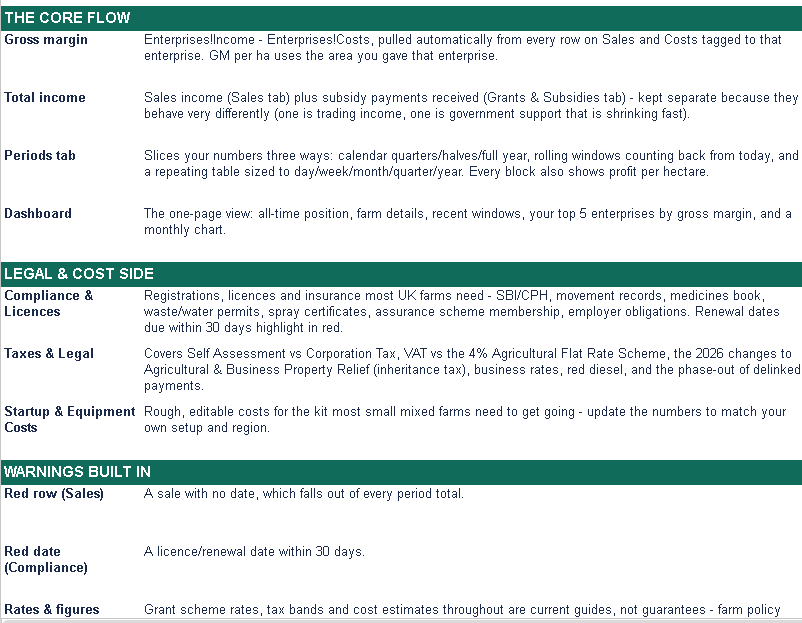
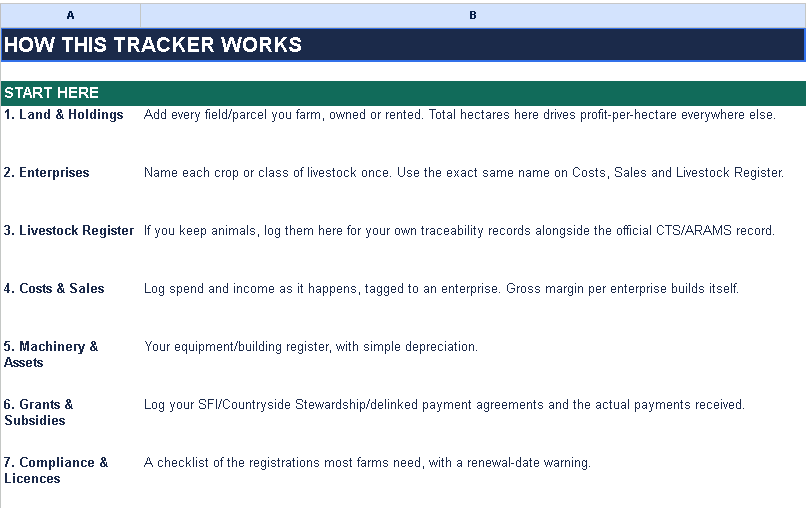
I have developed this Excel spreadsheet to help farmers and agricultural business owners keep track of their finances, from everyday running costs and incoming payments to business expenditure, profitability and other financial obligations.

The aim is to bring essential financial information together in one organised, easy-to-use workbook, making it easier to understand where money is coming from, where it is going and how those figures affect the overall financial position of a farming business.

The spreadsheet has been designed with simplicity in mind. Rather than requiring users to build their own formulas or perform calculations manually, it uses automated calculations, straightforward data-entry fields and selectable drop-down menus.

In most cases, you simply enter the relevant description, select the appropriate category from a drop-down menu and input the amount received or spent. The spreadsheet then performs the relevant calculations according to its built-in formulas.

An accompanying README document is provided to explain how to use the workbook, enter information correctly and understand its various sections.

Whether you operate a smallholding, manage a family farm or run a larger agricultural business, the spreadsheet is intended to provide a practical starting point for organising your financial records and gaining a clearer picture of your business's income, expenditure and profitability.

Important Disclaimer: Please Read Before Use
This spreadsheet is an independently developed financial management tool created by me. It is not an official accounting product and has not been independently certified, audited or approved by a qualified accountant, solicitor, tax adviser, financial adviser, government department or regulatory authority.

Although care has been taken in developing the workbook, I cannot guarantee that its formulas, calculations, categories or other features are free from errors or suitable for every farming business or legal jurisdiction.

The spreadsheet is provided for general record-keeping, financial organisation and informational purposes only. It does not constitute accounting, tax, financial or legal advice and should not be treated as a substitute for professional guidance.

Before relying on the spreadsheet for business decisions, tax returns, statutory reporting, regulatory compliance or other financial or legal obligations, please have it reviewed by a suitably qualified accountant, tax adviser or legal professional familiar with your business and the requirements of your jurisdiction.

Users remain responsible for checking the accuracy of their entries, verifying the resulting calculations and ensuring that their records and reporting comply with applicable laws and regulations.

The spreadsheet should not be assumed to satisfy HMRC requirements, Making Tax Digital obligations, VAT rules or any other statutory record-keeping requirements without independent verification.

The accompanying README document should be read in full before using the workbook.

A final note from the creator: This workbook has been developed to make farming finances easier to organise and understand. Feedback, suggestions and reports of any calculation errors are welcome, as they will help improve future editions.

Please retain copies of your original financial records and keep a backup of your completed spreadsheet.

Important: A disclaimer can help explain the intended use and limitations of your spreadsheet, but it cannot guarantee protection against legal claims or exclude liabilities that cannot lawfully be excluded. If you intend to distribute or sell the workbook, have a qualified solicitor review your disclaimer and any accompanying terms of use.

BUT IF YOU DID TAKE THIS SPREAD TO A LEGAL ADVISOR AND THEY TELL YOU WHAT MISSING ON IT AND YOU COME BACK HERE AND POST WHAT YOU FOUND OUT THEN I WILL UPDATE IT.
Write Topics About Farming Get Paid!

Announcements · 3 weeks ago

Image

Write Topics About Farming Get Paid!

Announcements · 3 weeks ago

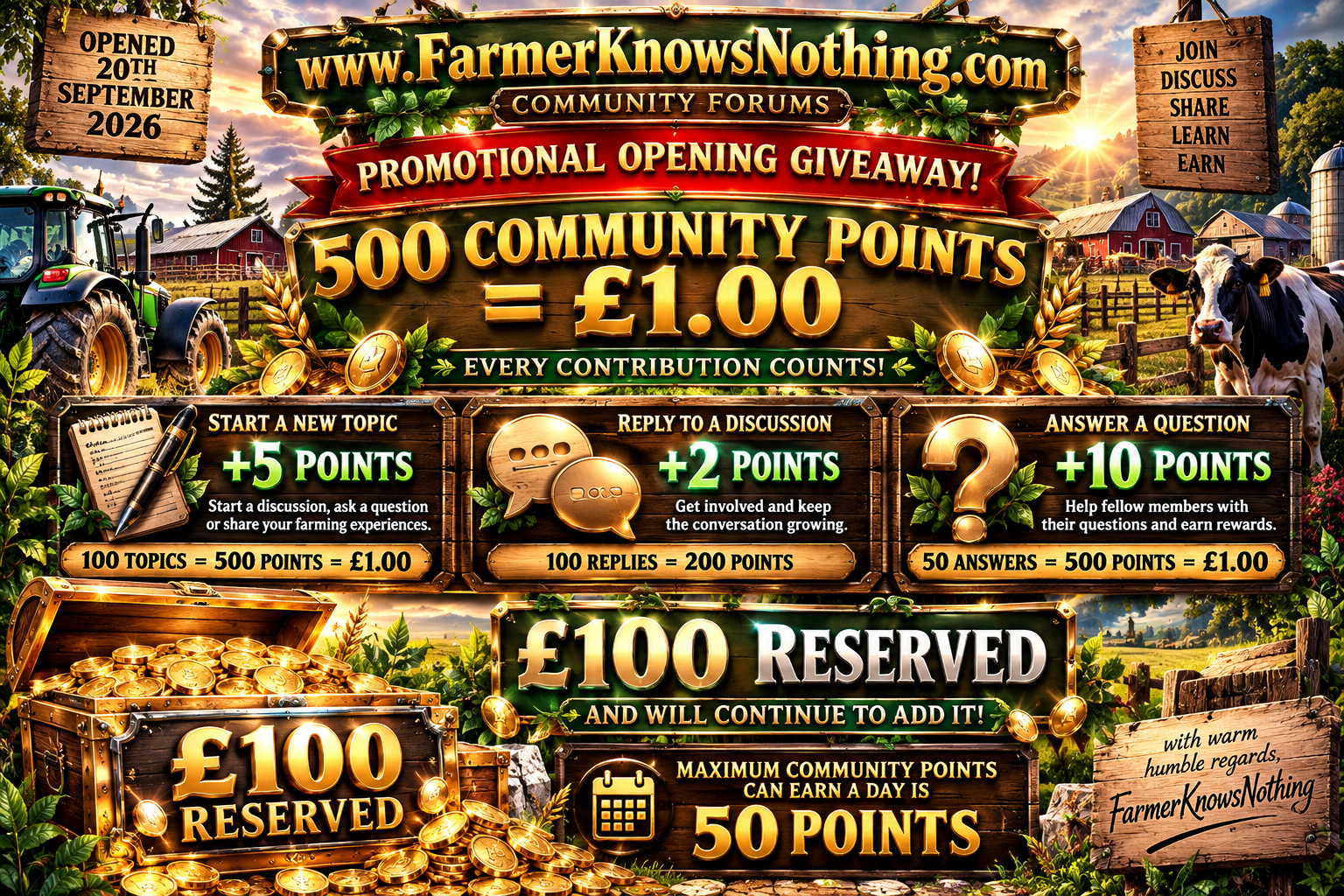
OPENED 20TH SEPTEMBER 2026 — AND WE’RE CELEBRATING WITH A COMMUNITY GIVEAWAY

Welcome to www.FarmerKnowsNothing.com
— a growing community for farmers, smallholders, gardeners and anyone passionate about agriculture, from complete beginners to experienced hands.

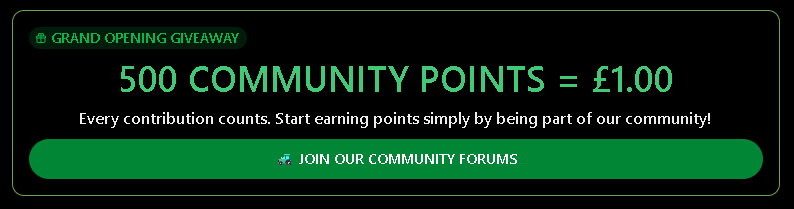
To celebrate our grand opening, we’re rewarding you for getting involved, sharing your knowledge and helping our community grow!

Image

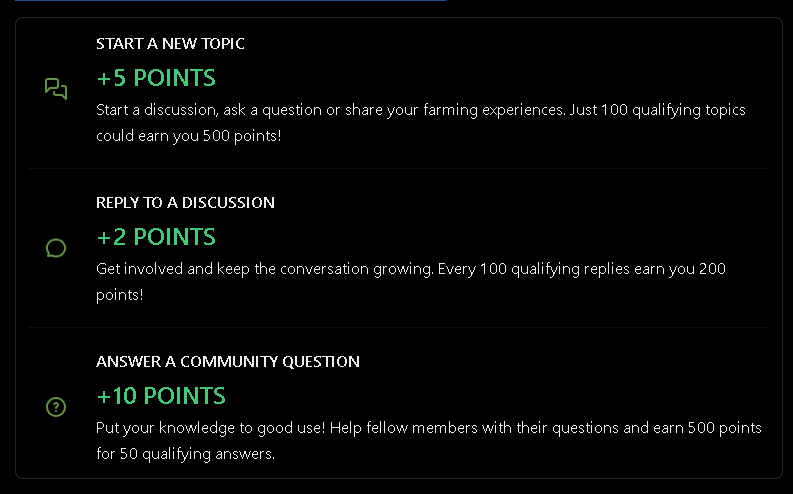
🌾 HOW TO EARN YOUR COMMUNITY POINTS

Image

🌻 EVERY CONTRIBUTION HELPS OUR COMMUNITY GROW!

Whether you’re asking your very first question, helping someone solve a problem or sharing what you’ve learned out in the field, there’s a place for you at FarmerKnowsNothing.com.

Join the conversation, share what you know and turn your community contributions into rewards!

With warm and humble regards,

The FarmerKnowsNothing Team (Just me right now)🚜🌾

Image

Grey Ferguson Tractor (FarmersKnowsNothing Compare Find)

eBay finds & price checks · 3 weeks ago

What it is: Grey Ferguson Tractor

Asking price and where I saw it: £2,041.60 and the compare find is below.

What I think it is worth, and why: £3000 to £7000, you can just tell, what you think?

Welcome to FarmerKnowsNothing!

New members & introductions · 3 weeks ago

I'm Ricardo — UK born, in my prime, and by my own admission a cheeky chap, though I like to think there's a heart of gold rattling around under the banter. I've spent enough years around good, hardworking people to know one thing for certain: farming doesn't come with a manual. Nobody hands you a rulebook when you take on your first field, your first flock, or your first tractor that refuses to start on a Monday morning. You learn by asking, by getting it wrong, by asking again — and that's exactly the spirit this place was built on.

What FarmerKnowsNothing actually is
FarmerKnowsNothing.com isn't trying to be the expert that talks down at you. It's the mate who says "no idea, but let's find out together" — hence the name, and hence our tagline: Ask anything. Nobody's born knowing.

Underneath that easy-going front door, there's a genuinely useful toolkit:

    Farmers everywhere, not just here
    Here's the bit I want to say plainly: this isn't a UK-only clubhouse. Whether you're farming in Yorkshire, Normandy, Nebraska, or anywhere else the sun happens to rise on a working field, you're welcome at the table. Advice shared here — by the community, by our guides, by me — comes from genuine experience and good intentions, but it is not professional advice. Farming law, safety rules, and best practice vary hugely by country and even by county. If a decision matters — money, safety, compliance — please treat what you read here as a starting point for a conversation, not the final word, and go get a second opinion from someone qualified where you farm.

    Why we've partnered with eBay
    Compare Deals runs on eBay's official Partner Network. We didn't build a scraper and we're not pretending to be neutral out of nowhere — we're upfront that when a listing sells through our links, we earn a small commission. What that partnership actually buys you is real, live, legitimate second-hand farm equipment listings, searchable properly, without us ever touching, storing, or reselling your data. It doesn't change what ranks higher on the page, and to be clear: FarmerKnowsNothing is not affiliated with or endorsed by eBay Inc. — we're simply a participant in their public partner programme, same as thousands of other independent sites.

    Does it actually help the business? Honestly — yes, and meaningfully so. Every farmer who finds a fair deal through Compare Deals is a farmer who trusts this site a little more, comes back, tells another farmer, and keeps the whole community alive. That trust is worth more to us long-term than any single commission cheque.

    The bigger picture: The Balance Wheel LTD
    FarmerKnowsNothing is a project of The Balance Wheel LTD — the same company behind our sister site, a proper British watchmaking venture. That's not a random detail; it's the whole point. The modest, honest revenue this platform generates — including through the eBay partnership — goes toward something we genuinely care about: raising the funding to design and build a watch made specifically for farmers across the UK and EU. Something rugged, useful, and worn by people who actually work with their hands, rather than sat in a glass case being admired from a distance.

    So when you post a question in the forum, browse a fair deal on Compare Deals, or just have a browse around — you're not just helping yourself. You're helping keep a genuinely useful farming community running, and putting a small brick in the wall of something built, quite literally, for people who get their hands dirty.

    Welcome aboard. Ask anything. Nobody's born knowing — and that includes me.

    Are new smallholders putting their dreams ahead of the practical realities of running a small farm?

    Starting a smallholding · 3 weeks ago

    There is something incredibly appealing about buying a few acres, keeping your own animals, growing your own food and gradually building a life that is less dependent on supermarkets and outside suppliers.

    But there is a question that I think every aspiring smallholder should seriously consider before spending their first pound:

    Are you actually ready to look after the land and livestock you want to own, or are you simply ready to buy them?

    Those are two very different things.
    One of the biggest mistakes a new smallholder can make is purchasing livestock before establishing the infrastructure, knowledge and financial security needed to care for them properly.

    A few chickens might seem like a straightforward introduction to smallholding. Sheep might look like an excellent way to manage grass. A couple of pigs might seem like the perfect opportunity to produce your own meat.

    However, every animal brings responsibilities that do not disappear when the weather turns, money becomes tight or enthusiasm begins to fade.

    What Should Come First: The Animals or the Infrastructure?
    Before introducing livestock, I believe there are several fundamental questions worth discussing.

    • Land and grazing: Can the land sustainably support the animals throughout the year, including during periods of poor weather or limited grass growth?
    • Fencing and security: Are the boundaries suitable for the species you intend to keep, and can they protect your animals from escaping or being injured?
    • Water and shelter: Is there a dependable supply of clean water, appropriate shelter and somewhere suitable to isolate an animal that becomes ill?
    • Veterinary care: Have you considered routine health requirements, emergency treatment, disease prevention and the costs involved?
    • Financial reserves: Could you still afford to care for your animals if feed prices increased, equipment failed or an unexpected veterinary bill arrived?

    There is also the often-overlooked issue of time. Animals need attention every day, including Christmas Day, during holidays and when you are unwell.

    For someone working full-time while establishing a smallholding, that responsibility can become much greater than initially anticipated.

    The Financial Reality Nobody Should Ignore
    A smallholding does not automatically become financially sustainable simply because you own the land.

    Feed, fencing, equipment, bedding, veterinary bills, insurance, maintenance and unexpected repairs can quickly consume a budget.

    Even growing your own food has costs, particularly when you consider tools, seeds, soil improvements, irrigation and the time required to produce a successful harvest.

    This raises an important question: should beginners focus on making their smallholding financially sustainable before introducing livestock, rather than assuming the animals will eventually pay for themselves?

    There is nothing wrong with keeping animals for enjoyment or producing food for your own household. However, understanding the difference between a lifestyle investment and a profitable agricultural enterprise is essential.

    The Question for the Community
    Imagine you were starting again with five acres of land, a limited budget and absolutely no farming experience.
    What would you spend your first £5,000 on, and what would you deliberately avoid buying during your first year?

    Would you prioritise fencing, water infrastructure, soil improvement and vegetable production before purchasing any animals? Or would you begin with a small flock and develop the rest of the holding around it?

    I would particularly like to hear from experienced smallholders who have already made expensive mistakes. What did you purchase too early? What turned out to be more costly than expected? And what is the one thing you wish somebody had told you before you started?

    The aim of this discussion is not to discourage anyone from pursuing their dream of owning a smallholding. It is to help newcomers understand what it genuinely takes to turn that dream into something sustainable.
    Because buying a few acres makes you a landowner. Learning how to manage those acres responsibly is what makes you a smallholder.