
Skip to content

Arable Farming: The Decisions That Determine Yield, Soil Health and Whether the Crop Actually Makes Money

farmerknowsnothing
farmerknowsnothing Admin

Stockperson

#31 ·

30. Grain moisture can decide whether today is the correct harvest day

Harvesting too wet can create substantial drying costs.

Waiting too long can risk:

- Lodging.
- Sprouting.
- Quality loss.
- Grain shedding.
- Storm damage.

The correct harvest decision therefore balances:

moisture cost versus field-loss risk.

This is particularly important for premium grain.

If wheat intended for milling begins losing quality, waiting for another percentage point of moisture reduction may ultimately cost more than drying it.
farmerknowsnothing
farmerknowsnothing Admin

Stockperson

#32 ·

31. Harvest 2026 showed why weather resilience matters

AHDB's final 2026 harvest report said that harvest progressed rapidly across much of England and Wales, but yields were very disappointing and highly variable after another season of limited rainfall from spring. Wetter conditions further north slowed harvest but were associated with somewhat higher reported crop moisture and some improvement in yields. AHDB

Earlier in the season, AHDB reported that harvest had begun exceptionally early, with some southern and eastern farms running two to three weeks ahead of the long-term average because of hot, dry conditions. AHDB

That is an important reminder.

A rotation built around yesterday's climate may not always perform the same way tomorrow.

farmerknowsnothing
farmerknowsnothing Admin

Stockperson

#33 ·

32. Water management is becoming more important

Arable farmers may increasingly have to manage two opposite problems:

Too little water

Drought can restrict:

- Establishment.
- Nutrient uptake.
- Grain filling.
- Yield.

Too much water

Excess rainfall can cause:

- Waterlogging.
- Erosion.
- Nutrient loss.
- Delayed drilling.
- Soil damage.

Improving soil structure helps with both extremes.

Well-structured soil can improve infiltration during wet periods and root exploration during dry periods.

farmerknowsnothing
farmerknowsnothing Admin

Stockperson

#34 ·

33. Grain storage is a marketing tool

Storage is not simply somewhere to put grain.

It gives the farm the potential to separate:

harvest date from sale date.

That flexibility can be valuable.

But storage is not free.

Costs can include:

- Buildings.
- Electricity.
- Ventilation.
- Drying.
- Pest control.
- Labour.
- Finance.
- Shrinkage.
- Insurance.

The higher future grain price needs to exceed those costs before delayed sale has actually improved the result.

farmerknowsnothing
farmerknowsnothing Admin

Stockperson

#35 ·

34. Monitor stored grain

Once grain enters the store, the job is not finished.

Monitor:

- Temperature.
- Moisture.
- Insects.
- Mould.
- Hotspots.
- Ventilation.

Poorly managed grain can lose quality after the farmer has already successfully grown and harvested it.

That is an avoidable loss.

farmerknowsnothing
farmerknowsnothing Admin

Stockperson

#36 ·

35. Marketing grain is risk management, not fortune telling

Nobody consistently knows the highest future grain price.

Trying to sell the entire crop at the absolute market peak is speculation.

A more structured approach may involve selling portions at different times.

For example:

- Some before harvest.
- Some at harvest.
- Some during storage.

That can reduce exposure to one single price point.

The correct strategy depends on the farm's:

- Cash flow.
- Storage.
- Debt.
- Contracts.
- Attitude to risk.

The objective is not always to achieve the best price anyone received.

It is to achieve a price that works for the business.

farmerknowsnothing
farmerknowsnothing Admin

Stockperson

#37 ·

36. Know your break-even grain price

This may be one of the most valuable figures in the entire enterprise.

Suppose wheat costs:

£1,600/ha

to produce fully.

Expected yield:

8 t/ha

Break-even:

£200/t

before any straw value or other adjustments.

If the available forward price is £215/t, the farmer can immediately understand approximately what margin is being offered.

Without a break-even calculation, £215/t is just a number.

farmerknowsnothing
farmerknowsnothing Admin

Stockperson

#38 ·

37. Precision farming should solve a problem

Technology now allows arable farms to use:

- GPS.
- Autosteer.
- Yield mapping.
- Variable-rate fertiliser.
- Variable-rate seed.
- Satellite imagery.
- Drone imagery.
- Soil scanning.
- Section control.

These can reduce overlaps and improve management.

But technology should have a measurable purpose.

Do not buy a £30,000 system simply because the neighbouring farm has one.

Ask:

What problem will this solve, and what will the financial return be?

farmerknowsnothing
farmerknowsnothing Admin

Stockperson

#39 ·

38. Yield maps are especially valuable when combined with other information

A poor-yielding section of a field might result from:

- Compaction.
- Poor drainage.
- Soil type.
- pH.
- Weed pressure.
- Nutrient deficiency.

The yield map identifies the pattern.

Then investigate it.

Precision agriculture is most valuable when it helps farmers ask better questions rather than simply producing colourful maps.

farmerknowsnothing
farmerknowsnothing Admin

Stockperson

#40 ·

39. Environmental schemes should fit the farm, not distort it

England's SFI26 included actions covering areas such as:

- Integrated pest management.
- Nutrient management.
- Soil health.
- Precision farming.
- Farmland wildlife.
- Water protection. GOV.UK

As of 30 September 2026, SFI26 is closed to new applications because the allocated budget was reached. Existing agreement holders remain subject to the relevant scheme requirements. GOV.UK

That status matters because farm-support schemes change.

Never construct a five-year cropping budget around an assumed payment without checking current eligibility and rules.

Environmental management should also make agronomic sense where possible.

Margins, awkward corners and difficult areas can sometimes produce limited crop value while offering useful environmental opportunities.

farmerknowsnothing
farmerknowsnothing Admin

Stockperson

#41 ·

40. Do not automatically treat every hectare equally

One of the most important uses of precision data is discovering that some parts of fields may repeatedly lose money.

Imagine an awkward field corner repeatedly yields poorly because of:

- Shade.
- Waterlogging.
- Soil damage.
- Machinery overlap.

The farm may spend the same seed, fertiliser and crop-protection money there every year.

Yet the output may never justify the inputs.

Sometimes the correct decision is to repair the problem.

Sometimes it is to change the management of that area.

Producing maximum yield from every square metre is not always the same as maximising farm profit.

farmerknowsnothing
farmerknowsnothing Admin

Stockperson

#42 ·

41. Biodiversity and production do not have to be enemies

Arable farms depend on functioning ecosystems.

Beneficial insects can contribute to pest control.

Pollinators matter for certain crops.

Field margins, hedgerows and habitat areas can support wildlife.

The challenge is integrating those features without undermining productive farming.

A field does not necessarily have to choose between:

food or nature.

Management can sometimes accommodate both.

The practical outcome depends on the farm, crop and landscape.

farmerknowsnothing
farmerknowsnothing Admin

Stockperson

#43 ·

42. Know the farm's carbon position, but understand the methodology

Arable emissions can come from:

- Nitrogen fertiliser production.
- Nitrous oxide from soils.
- Diesel.
- Drying.
- Machinery.
- Purchased inputs.

Possible mitigation can include:

- Improved nitrogen-use efficiency.
- Reduced unnecessary cultivation.
- Renewable energy.
- Efficient machinery.
- Soil carbon management.

But carbon calculators can use different assumptions.

Therefore:
Do not compare two farms' carbon numbers unless the calculation methodology is comparable.

farmerknowsnothing
farmerknowsnothing Admin

Stockperson

#44 ·

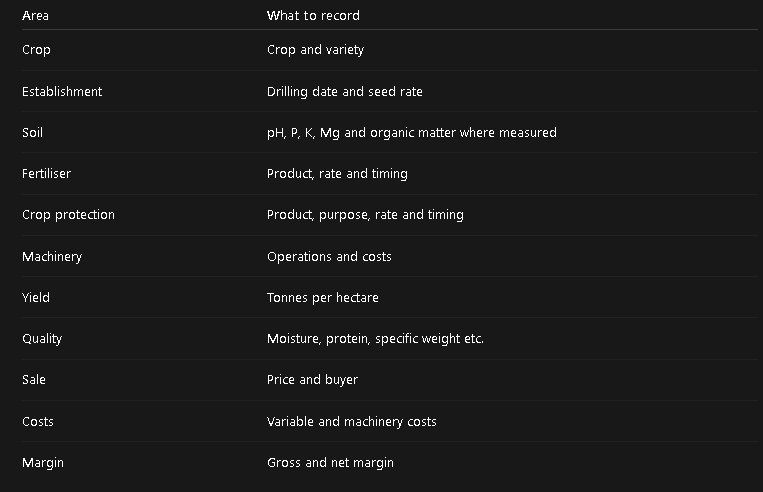
43. Record field-level performance

Whole-farm averages can hide poor fields.

Each field should ideally have a record containing:

Image

After several years, patterns become visible.

You may discover that one field consistently performs badly under winter wheat but performs well under spring barley.

That information can change the rotation.

farmerknowsnothing
farmerknowsnothing Admin

Stockperson

#45 ·

44. A field should have a profit map as well as a yield map

Imagine this:

Field A

10 t/ha wheat.

Very high fertiliser and fungicide input.

Field B

8.5 t/ha wheat.

Much lower input cost.

The yield map declares Field A the winner.

The financial calculation may disagree.

Precision agriculture increasingly needs to move from:

Yield mapping

to:

Profit mapping.

That may be one of the most useful changes arable farming can make.

Sign in or create an account to reply.