
Skip to content

Dairy Cattle Farming: The Decisions That Determine Herd Health, Milk Quality and Long-Term Profitability

farmerknowsnothing
farmerknowsnothing Admin

Stockperson

#1 ·

Milking, yields, parlours, mastitis and the daily routine — what every dairy farmer should understand about running a productive, healthy and financially sustainable herd.

Dairy farming is one of the few agricultural enterprises where production, animal welfare and business performance must be managed every single day of the year.

A beef farmer may have some flexibility over when cattle are marketed, but a dairy farmer cannot simply postpone milking because milk prices have fallen, feed costs have increased or machinery has broken down.

Cows still need to be milked, calves must be fed, animals require attention and the milk collection schedule continues.

That constant responsibility makes dairy farming a particularly demanding business.

But the greatest mistake is to assume that the most successful dairy herd must be the herd producing the most milk.

A cow producing 12,000 litres a year is not necessarily more profitable than one producing 8,000 litres. The difference depends on feed costs, milk composition, fertility, veterinary expenditure, longevity, labour requirements and the milk contract.

The real measure of a successful dairy enterprise is not simply how much milk leaves the farm. It is how much sustainable income remains after producing that milk while maintaining the health and welfare of the herd.

This discussion focuses primarily on UK dairy farming, although the principles of herd management, milk quality, milking hygiene and cost control apply to dairy farmers worldwide.

1. The first rule of dairy farming: Know your true cost per litre
One of the most important figures in a dairy business is the cost of producing each litre of milk.

A farmer may know the current milk price to a fraction of a penny, yet still be uncertain about the full cost of producing that milk.

The difference between those two figures determines whether the enterprise is genuinely making money.

What does a litre of milk actually cost?
A proper cost-of-production calculation should include:

- Purchased feed, home-grown forage and grazing costs.
- Veterinary treatment, medicines, breeding and fertility management.
- Bedding, disinfectants, cleaning chemicals and parlour consumables.
- Electricity, water, milk cooling and refrigeration.
- Machinery, fuel, repairs, buildings and depreciation.
- Replacement heifers and youngstock rearing.
- Labour, including the farmer's own time.
- Land, rent, finance, insurance and administration.
- Milk collection charges, levies and other relevant deductions.

A farm that excludes the cost of its own labour, owned land or machinery depreciation can appear more profitable than it really is.

The calculation should also distinguish cash costs from full economic costs. Both matter: cash costs determine whether the business can meet its bills, while full economic costs help establish whether it is adequately rewarding the resources invested.

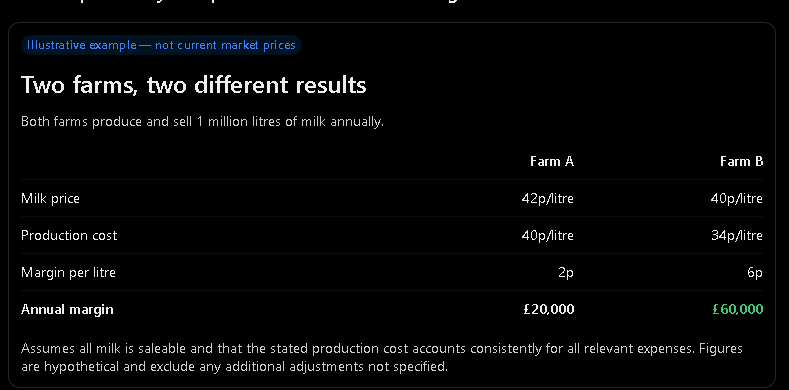
An example of why milk price alone can be misleading
Image

Farm B receives a lower price but generates a greater margin because its production costs are lower.

That does not mean every farmer should adopt a low-input system. Some higher-input farms achieve excellent financial performance because their additional investment produces sufficient extra income.

The point is to understand the relationship between expenditure, output and the actual return on that expenditure.
Producing more milk is only a financial improvement when the value of the additional milk exceeds the cost of producing it.

2. Milk yield: More litres are not always better
Milk yield is one of the easiest figures to measure on a dairy farm. It is also one of the easiest to misunderstand.

A cow producing 40 litres per day may appear more valuable than one producing 28 litres. However, that comparison is incomplete without considering milk components, feed intake, lactation stage, fertility, health and longevity.

A higher-yielding cow may require more energy-dense feed and more intensive management to maintain her condition and reproductive performance.

A lower-yielding cow in a well-managed grazing system may produce a smaller milk cheque but also incur substantially lower feed costs.

The appropriate system depends on the farm's land, buildings, climate, labour availability and milk contract.
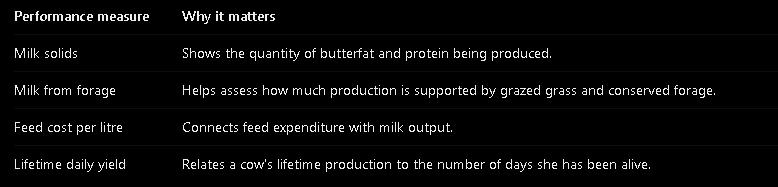
Four figures worth measuring alongside yield

AHDB's dairy performance guidance identifies several technical and financial indicators that can help farmers understand the efficiency of their individual systems. (AHDB)
Image

Lifetime daily yield is especially interesting because it exposes a problem that annual production figures can conceal.

An animal producing a large quantity of milk for one lactation but leaving the herd prematurely may return less over her lifetime than a moderately yielding cow that remains productive for several lactations.

This is one reason fertility, lameness prevention and udder health should be considered alongside milk yield rather than treated as separate issues.

3. Milking routines: Consistency protects milk quality and cow health
Milking is not simply the process of attaching a cluster and collecting milk.

The way cows enter the parlour, how teats are prepared, the timing of cluster attachment and the condition of the milking equipment can affect milk quality, udder health and cow comfort.

A consistent routine helps minimise variation between milkers and provides a clear process for identifying problems.

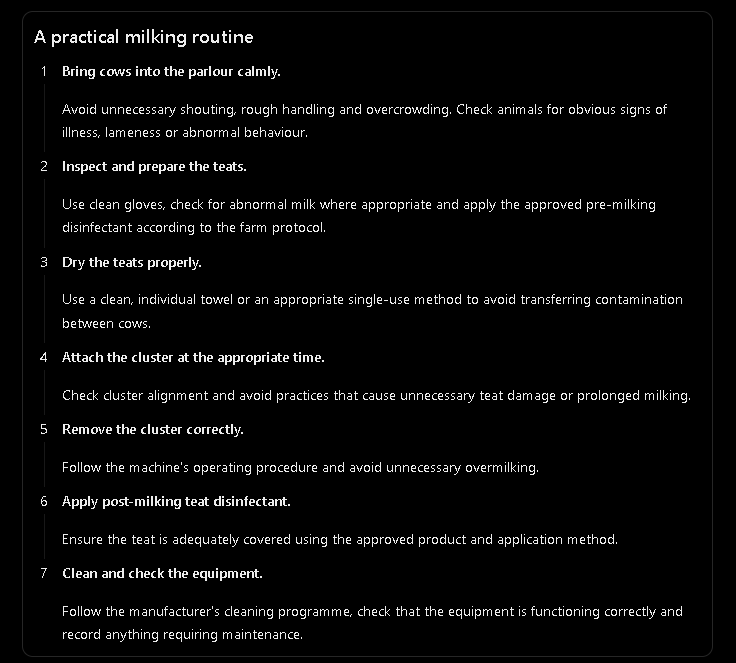
What does good milking preparation involve?
AHDB recommends putting clusters on calm cows with clean, dry, well-stimulated teats. Its guidance recommends allowing pre-milking disinfectant at least 30 seconds of contact time, with an interval of approximately 60–120 seconds between initial teat stimulation and cluster attachment. (AHDB)

The appropriate procedure should follow the disinfectant manufacturer's instructions and the herd's agreed milking protocol.
Image

One important point is that a good routine must be practical enough to follow during every milking, including when relief staff are working or the farm is under pressure.

A complicated procedure that is regularly skipped offers less protection than a properly designed routine that is consistently followed.

4. Mastitis: One of the most expensive problems in a dairy herd

Mastitis is inflammation of the mammary gland, commonly associated with infection. It can cause pain, reduced milk production, abnormal milk and, in severe cases, serious systemic illness.
It is both an animal welfare problem and a financial problem.

AHDB estimates that a clinical mastitis case can cost approximately £250–£300 on average, although the cost varies with severity, treatment, lost milk and other circumstances. Its Mastitis Control Plan is designed to identify farm-specific causes and prioritise preventative action. (AHDB)

Understand the two broad sources of mastitis

Contagious mastitis
Infection may spread between cows, including during milking through contaminated equipment or contact. Good milking hygiene, infection monitoring and appropriate management of affected cows are important controls.

Environmental mastitis
Infection originates from organisms in the cow's surroundings, such as contaminated bedding, manure or wet and dirty lying areas. Clean, dry housing and hygienic teat preparation are important preventative measures.

This distinction matters because purchasing a new teat disinfectant will not necessarily solve a mastitis problem caused primarily by dirty, overcrowded cubicles.

Likewise, improving bedding may not resolve infections being transmitted through an inadequate milking routine.

The first step is to establish where and when new infections are occurring.
Somatic cell count: What does it actually tell you?
Somatic cell count, commonly abbreviated to SCC, is an important indicator of udder health.

A higher SCC can indicate inflammation or infection in the udder, although an individual result must be interpreted in the context of the cow and her health history.

A bulk tank SCC is useful for monitoring herd-level milk quality, but it cannot identify every infected cow.
Individual milk recording can help identify persistent high-cell-count animals, emerging infections and patterns associated with particular stages of lactation.

AHDB's mastitis guidance emphasises identifying infection sources and understanding whether problems are occurring during lactation or the dry period. (AHDB)

What should happen when mastitis is suspected?
Abnormal milk, a swollen or painful udder, reduced yield or a cow showing signs of illness requires prompt assessment.

The farm's veterinary mastitis protocol should determine sampling, treatment, monitoring and escalation.

Severe cases, especially when a cow is systemically unwell, require urgent veterinary attention.

Antibiotic treatment should be guided by the veterinary diagnosis, the likely pathogen and appropriate medicine-use requirements. Not every case requires the same treatment.

Milk from treated cows must be identified and excluded from the saleable supply for the applicable withdrawal period.

The most effective mastitis strategy is not simply treating more cases. It is understanding why new infections occur and preventing them wherever possible.

5. Milking parlours: The most expensive equipment is not always the most suitable
A milking parlour is one of the most important investments a dairy farmer can make.

It influences labour requirements, cow movement, milking time, udder health, electricity consumption and the farm's ability to expand.

But buying a larger parlour or installing robots does not automatically improve profitability.

The correct investment depends on herd size, available labour, existing buildings, cow traffic, financing and the farm's long-term business plan.

Understanding the main milking systems

Herringbone parlour
Cows stand at an angle to the operator pit. This is a familiar arrangement on many dairy farms and can suit different herd sizes. Performance depends on the number of milking points, cow flow and equipment.

Parallel parlour
Cows stand side by side, generally at right angles to the operator pit. It can provide efficient use of space and allow groups to exit together, depending on the installation.

Rotary parlour
Cows enter individual stalls on a slowly rotating platform. Rotary systems can accommodate substantial milking throughput, although capital costs, maintenance and operational requirements must be carefully assessed.

Robotic milking
Automatic milking systems allow cows to be milked without an operator attaching every cluster manually. They can change how labour is organised, but require management of cow traffic, machine capacity, cleaning, alarms and animals that do not attend voluntarily.
farmerknowsnothing
farmerknowsnothing Admin

Stockperson

#2 ·

Should every dairy farm invest in robotic milking?

Robotic milking is an attractive option for farmers who want to reconsider the traditional morning and evening milking routine.

However, robots do not eliminate the need for labour.

Cows still need monitoring, equipment requires cleaning and servicing, and staff must respond to faults and animal-health alerts.

Before investing, farmers should calculate the total ownership cost over the expected working life of the equipment.

That calculation should include installation, building alterations, finance, maintenance contracts, consumables, electricity, replacement parts and any changes to labour requirements.

The same principle applies to conventional parlour upgrades.

A successful parlour investment should improve the overall operation of the farm, not simply make the milking equipment more impressive.

6. Feeding dairy cows: Feed efficiency matters more than feed volume
Feed is one of the largest operating expenses in many dairy enterprises.

It is also one of the most important factors influencing milk production, fertility, body condition and animal health.

Dairy cows need sufficient energy, protein, effective fibre, minerals and vitamins appropriate to their stage of lactation, body condition and production requirements.

A ration that supports a freshly calved cow may be unsuitable for a dry cow.
Likewise, the nutritional requirements of a rapidly growing replacement heifer differ from those of a mature milking animal.

Why forage quality matters
AHDB's Forage First guidance encourages farmers to maximise the effective use of grazed grass and conserved forage, with purchased feed used to meet the remaining nutritional requirements. (AHDB)

The financial advantage of producing more milk from forage depends on forage quality, production costs, feed availability and the requirements of the herd.

Poor-quality silage can limit intake and performance, particularly in high-yielding cows.

Forage analysis helps a nutritionist formulate a ration based on what the cattle are actually eating rather than assumptions about the feed.

The importance of monitoring the ration
A ration that looks correct on paper may not perform as expected on the farm.

Farmers should monitor milk output, feed intake, body condition, dung consistency, health and fertility. AHDB identifies these as important ways to assess whether a dairy diet is delivering the intended results. (AHDB)

Feed refusals, sorting, restricted feed access and inconsistent mixing can all affect what individual animals consume.

Water access is equally important. Clean drinking water should be readily available, with enough trough space and flow capacity to meet demand.

7. Fertility: A cow that produces milk but cannot get back in calf creates a longer-term problem
Fertility is central to herd performance.

A cow that fails to conceive may remain in milk longer than intended, require additional breeding interventions or leave the herd prematurely.

Poor reproductive performance can also increase replacement costs and disrupt the planned calving pattern.

Why calving strategy matters
Dairy farms generally organise calving around their production system.

All-year-round calving spreads births and milk production throughout the year, while block calving concentrates births into a defined period.

Block calving can help seasonal systems match feed demand and milk production with grass availability, but it places particular importance on timely conception and a compact calving period.

AHDB publishes separate performance indicators for all-year-round and block-calving herds because the two systems have different management objectives. (AHDB)

A fertility review should consider heat detection, service records, pregnancy diagnosis, nutrition, calving difficulties and the incidence of reproductive disease.

Body-condition scoring is particularly useful around calving and early lactation.

Cows that lose excessive condition after calving may experience additional health and reproductive challenges.

Replacement heifers are a substantial investment
A replacement heifer consumes feed, requires housing and veterinary care, and occupies land before producing saleable milk.

Heifer-rearing costs should therefore be measured separately rather than hidden within the general herd expenditure.

Age at first calving, growth rates, health and survival all influence the cost of producing a replacement.

AHDB's all-year-round calving guidance identifies calving at approximately 24 months as a useful performance objective for appropriately managed heifers. (AHDB)

However, heifers must achieve suitable physical development and body condition. An arbitrary calving-age target should never take precedence over their welfare.

8. The transition period: A few weeks that can influence an entire lactation

The transition period covers the weeks around calving, when a cow moves from late pregnancy into milk production.
It is a time of substantial nutritional and physiological change.

Feed intake, energy requirements, calcium metabolism and immune function all need careful consideration.

Poor transition management can contribute to problems such as milk fever, ketosis, displaced abomasum, retained fetal membranes and other post-calving disorders.

These conditions can affect milk yield, fertility, treatment costs and the cow's ability to remain productive.

Transition management should cover appropriate dry-cow nutrition, suitable body condition, sufficient feed and water access, comfortable lying areas and close observation around calving.

Freshly calved cows should be monitored for appetite, demeanour, milk production and signs of illness.

Where problems recur, the farmer should review the transition programme with the veterinary surgeon and nutritionist rather than treating each case as an isolated incident.

9. Calf rearing: The future herd starts before the first milk cheque

Replacement heifers represent the future productive capacity of a dairy enterprise.

Poor calf management can affect survival, growth, health and subsequent performance.

The first priority after birth is ensuring that the calf receives sufficient high-quality colostrum promptly.

In England, the cattle welfare code sets out the legal requirement for calves to receive bovine colostrum as soon as possible and within their first six hours of life. It also sets out inspection, feeding, drinking-water and accommodation requirements for calves. (GOV.UK)

The farm should have a documented colostrum protocol developed with its veterinary surgeon.

Calf pens and feeding equipment must be kept clean, and animals should be monitored for diarrhoea, respiratory illness, dehydration and poor growth.

Calves that become ill need prompt assessment and appropriate treatment.

What happens to calves not retained for the dairy herd?

The management of dairy-bred calves is an important part of the enterprise.

Farmers should plan breeding and marketing arrangements for calves that will not be retained as replacements.
Options may include dairy-beef breeding, rearing calves for beef production or selling suitable calves into an established rearing system.

Those arrangements should be considered before breeding decisions are made.
Animal welfare, transport suitability, disease prevention, buyer requirements and the economics of rearing must all be taken into account.

10. Lameness and cow comfort: The hidden cost of poor housing and movement
Lameness can cause significant pain and affect a cow's ability to walk, feed, rest and reach the milking area.

It can also reduce production and increase treatment and replacement costs.

Prevention requires attention to hoof health, flooring, tracks, handling, housing and nutrition.

What should farmers examine?

The condition of the cow's environment is an important starting point.

Slippery or abrasive flooring, sharp turns, poorly maintained tracks and prolonged standing may all contribute to hoof problems.
Cubicles should allow animals to lie down and rise comfortably, with appropriate bedding and sufficient space.

Overcrowding can restrict access to feed, water and lying areas.

Routine mobility scoring helps identify changes in how cows walk. Animals showing abnormal movement need prompt assessment, with hoof treatment carried out by appropriately trained personnel and veterinary involvement where required.

The RSPCA identifies lameness as an important dairy-cow welfare concern across production systems. (RSPCA)

A profitable dairy system must allow cows adequate time to rest as well as sufficient opportunity to eat and drink.

11. Milk quality and the milk contract: Understand exactly what the buyer pays for

Dairy farmers do not all receive the same price for the same quantity of milk.

Payment may depend on milk composition, hygiene results, supply volumes, seasonal production, collection arrangements and the contract's pricing structure.

Butterfat and protein can change the value of a litre
Milk contains water, fat, protein, lactose and minerals.

Different processors value these components differently depending on the products they manufacture.

For example, a manufacturing contract may place substantial value on butterfat and protein, whereas another contract may use a different pricing structure.

AHDB's Milk Price Calculator allows farmers to compare contracts using common assumptions about milk composition, delivery volumes and quality measurements. (AHDB)

The useful comparison is the expected price for the milk your own herd produces, not simply the headline price advertised for a standard litre.

Milk hygiene and antibiotic residues
Milk quality management includes hygiene throughout milking, cooling, storage and collection.

Abnormal milk and milk subject to veterinary medicine withdrawal restrictions must be kept out of the saleable supply.
Clear cow identification, treatment records and an agreed procedure for handling withheld milk are essential.

A single mistake involving treated milk can have consequences extending beyond the individual cow, potentially affecting the bulk tank and the farm's commercial relationship with its buyer.

Understand the contract before signing
The UK's Fair Dealing Obligations (Milk) Regulations 2024 introduced requirements covering written milk purchase contracts and matters including pricing terms, contractual changes and dispute resolution. The requirements apply according to the scope and provisions of the regulations. (Legislation.gov.uk)

Farmers should understand the pricing formula, volume requirements, deductions, notice periods and the procedures available if a contractual disagreement arises.
Independent legal advice may be appropriate before entering into a substantial long-term supply agreement.

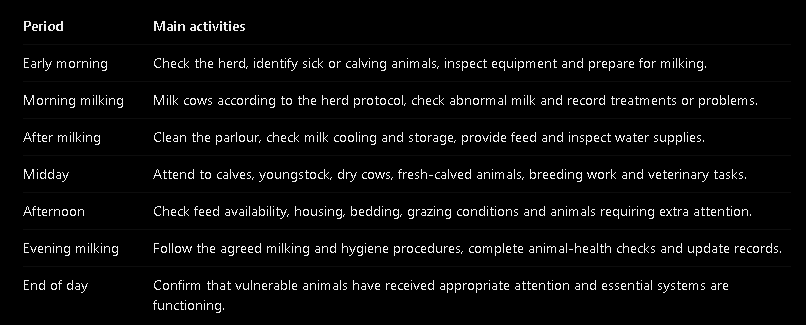
12. The daily routine: A reliable system is better than relying on memory

Dairy farming has a major operational challenge: essential work continues whether the usual farmer is available or not.

A good daily routine should therefore be clearly documented and understandable to competent relief staff.

An example of a general dairy routine is shown below. Actual timing and procedures depend on the herd, production system and welfare requirements.

Image

Automatic milking changes the scheduling of work but does not remove the need for monitoring, cleaning and responding to alarms.

What if the parlour breaks down?
Every dairy farm should have a practical emergency plan.

The plan should cover power failure, loss of cooling, water-supply interruption, milking-machine breakdown, staff shortages and other events that could prevent normal animal care or milk collection.

Emergency contact details, equipment instructions and arrangements for alternative technical support should be readily accessible.

13. Labour and safety: The farmer is part of the production system

Dairy farming can involve long hours, repetitive physical work and regular contact with large animals and machinery.

A business that depends entirely on one person's ability to work every day is vulnerable if that person becomes injured, ill or unavailable.
Proper training, reliable relief arrangements and safe working facilities are therefore business necessities.

The Health and Safety Executive identifies cattle handling as a significant agricultural hazard and recommends suitable handling facilities, competent workers and appropriate risk controls. (HSE)

Milking pits, electrical equipment, chemicals, slurry systems, tractors and livestock handling areas all require appropriate safety procedures.

Staff should understand how to report hazards, respond to emergencies and identify animals that need specialist attention.

It is also important to consider working hours and fatigue when planning staffing arrangements.

A dairy business should be designed so that its daily operation does not depend on one exhausted person being available indefinitely.

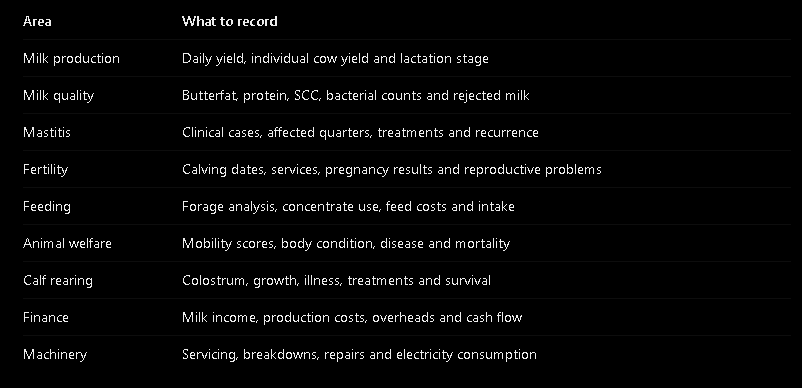
14. Record-keeping: Turn everyday observations into better decisions

Dairy farms can generate a considerable amount of information, but that information is only useful when it supports practical decisions.

A record-keeping system should connect animal performance with the costs and income of the enterprise.

Image

Farmers should be able to identify trends, not simply individual incidents.

For example, an increase in SCC alongside a rise in mastitis cases may indicate that infection control needs reviewing.

A reduction in milk yield accompanied by lower feed intake could suggest a feeding, health or environmental problem.

The important point is to investigate the cause rather than automatically assuming the solution is to increase concentrate feeding.

15. A practical annual review for every dairy enterprise

At least once a year, farmers should review both technical and financial performance with their relevant advisers.

The objective is to identify which changes will produce measurable improvements without compromising animal welfare.

[ ] Do we know our full cost of production per litre?
[ ] How much milk are we producing from forage?
[ ] What are our individual cow and bulk tank SCC trends?
[ ] How many clinical mastitis cases have occurred?
[ ] Are we monitoring fertility and replacement rates?
[ ] Are calves achieving suitable growth and health outcomes?
[ ] Do our cows have adequate lying, feeding and drinking space?
[ ] Are our milking equipment and cooling systems properly maintained?
[ ] Does our milk contract reward the milk composition and supply pattern we produce?
[ ] Are our staffing and emergency arrangements sufficient to maintain animal welfare?

The bigger discussion: Are dairy farmers being paid for the full cost of producing milk?

Dairy farming presents a difficult commercial reality.

Milk must be produced continuously, but the cost of producing it and the price received can change substantially over time.
Feed, electricity, fuel, fertiliser, labour and veterinary costs may rise while the milk price remains unchanged or falls.

The farmer cannot necessarily reduce production immediately without consequences for animal welfare, herd management and future productivity.

This means that dairy farmers face a business challenge that is not fully captured by the headline price per litre.

The September 2026 AHDB wholesale market report illustrates how different dairy products can move in different directions. The report records rising indicative prices for butter, skimmed milk powder and mild Cheddar during its reporting period, but also notes that these wholesale figures do not necessarily represent the prices achieved by individual milk processors. (AHDB)

These market movements do not automatically translate into an equivalent change in the price paid to every dairy farmer.
Milk contracts, processing arrangements and commercial commitments can all influence the relationship between wholesale markets and farmgate prices.

Farmers therefore need to understand not only their own cost of production but also how their milk is priced and what commercial risks their contract leaves them carrying.
The question every dairy farmer should be asking

If a farm improves milk yield but increases its feed bill, has it genuinely become more efficient?

If a new parlour reduces milking time but creates substantial finance and maintenance costs, how long will it take for that investment to pay for itself?

If a farmer receives a higher milk price but experiences more mastitis, higher replacement costs and poorer fertility, is the business actually moving forward?

These questions are worth asking because dairy profitability is not determined by one figure.
It comes from the combined performance of the herd, land, buildings, people, equipment and commercial arrangements.

A question for the farming community
For those currently running dairy herds, working in parlours or managing replacement youngstock, what has made the greatest difference to your operation?

Has it been improving forage quality, reducing mastitis, investing in a new parlour, adopting robotic milking, changing your breeding strategy or negotiating a different milk contract?

And for farmers who have experienced a difficult period of low milk prices, which changes helped protect your business without compromising the health and welfare of your cattle?

There is considerable value in farmers sharing practical experience, particularly when it includes real production costs, milk-quality results and the financial consequences of management decisions.

A dairy farm should not be judged solely by the number of litres it produces. Its long-term success depends on healthy cows, a capable workforce, productive land, reliable equipment and a business that earns enough to sustain them all.

Important
A disclaimer can help explain the intended use and limitations of your spreadsheet, but it cannot guarantee protection against legal claims or exclude liabilities that cannot lawfully be excluded. If you intend to distribute or sell the workbook, have a qualified solicitor review your disclaimer and any accompanying terms of use.

Sign in or create an account to reply.